Hokyointo
Tibetan Buddhist Encyclopedia is now 14 years old
Our Encyclopedia recently received a wonderful opportunity for a major renewal on its 14th birthday . After many years of growing our Encyclopedia had become bit slow and sometimes even decided not to answer when people knocked on the door.
A very big thank you and blessings to Dmytro Rudiy (rudiy.nl) for his great work in upgrading the server, website and all of the infrastructure and helping make TBE fast and reliable again for everyone! 🙏🙏🙏
We kindly ask our readers to help us cover the cost of this important upgrade and also help with the ongoing costs of keeping the Encyclopedia alive and freely available.
 or card
Every little donation helps and every one is deeply appreciated. 🙏🙏🙏
OM AH HUM VAJRA GURU PADMA SIDDHI HUM 🙏🙏🙏
May blessings shower down on all of yous 🙏🙏🙏

A hōkyōintō (宝篋印塔?) is a Japanese pagoda, so called because it originally contained the Hōkyōin (宝篋印?) dharani (陀羅尼?) sūtra. A Chinese variant of the Indian stūpa, it was originally conceived as a cenotaph of the King of Wuyue - Qian Liu. Structure and function
Usually made in stone and occasionally metal or wood, hōkyōintō started to be made in their present form during the Kamakura period. Like a gorintō, they are divided in five main sections called (from the bottom up) kaeribanaza (反花座?), or "inverted flower seat", kiso (基礎?), or base, tōshin (塔身?), or body, kasa (笠?), or umbrella, and sōrin (相輪?), or pagoda finial. The tōshin is the most important part of the hōkyōintō and is carved with a Sanskrit letter. The 'sōrin has the same shape as the tip of a five-storied pagoda. The kasa can also be called yane (屋根?), or roof. It's decorated with four characteristic wings called mimikazari (耳飾?) or sumikazari (隅飾?). Different structures exist, and the hōkyōintō property of the Yatsushiro Municipal Museum in Kyushu for example is divided in just four parts, with no kaeribanaza.
The sūtra contain all the pious deeds of a Tathagata Buddha, and the faithful believe that praying in front of a hōkyōintō their sins will be canceled, during their lives they will be protected from disasters and after death they will go to heaven.
The hōkyōintō tradition in Japan is old and is believed to have begun during the Asuka period (550–710 CE). They used to be made of wood and started to be made in stone only during the Kamakura period. It is also during this period that they started to be used also as tombstones and cenotaphs.
-
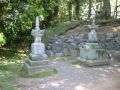 Hōkyōintō at Ishiyama-dera (Otsu)
 -
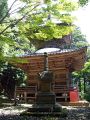 Hōkyōintō at Onsen-ji (Toyooka)
 -
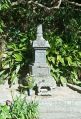 Hōjō Masako's Hōkyōintō (Kamakura)
 -
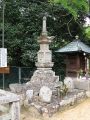 Hōkyōintō at Mizuma-dera near Osaka


