Buddhist fashion
Tibetan Buddhist Encyclopedia is now 14 years old
Our Encyclopedia recently received a wonderful opportunity for a major renewal on its 14th birthday . After many years of growing our Encyclopedia had become bit slow and sometimes even decided not to answer when people knocked on the door.
A very big thank you and blessings to Dmytro Rudiy (rudiy.nl) for his great work in upgrading the server, website and all of the infrastructure and helping make TBE fast and reliable again for everyone!
We kindly ask our readers to help us cover the cost of this important upgrade and also help with the ongoing costs of keeping the Encyclopedia alive and freely available.
 or card
Every little donation helps and every one is deeply appreciated. 🙏🙏🙏
OM AH HUM VAJRA GURU PADMA SIDDHI HUM 🙏🙏🙏
May blessings shower down on all of yous 🙏🙏🙏


During the time of the Buddha and earlier, it was common for seekers of enlightenment to shed their clothes and go around as naked ascetics. The Buddha's path is a Middle Way and requires clothes to be worn by monastics and lay people. Clothes are significant in Buddhism for this reason and also by the fact that beautiful clothes were described as a sign of merit or attainment. In the Vimanavatthu and Petavatthu there are stories of departed beings who have gone to good and bad destinations in the Buddhist cosmology. Moggallana through the powers of the mind with meditation visited these regions to inquire what deeds led them there. The woeful states were inhabited by beings who were described as naked, while those residing in heavenly mansions were described as possessing beautiful clothes. In the Theravada commentaries (DA ii.427, DhSA, 33) one of the signs of a deva's (heavenly being) imminent death is that the clothes becomes soiled, which again points to the significance of clothes in Buddhism.
Lay people have no specific requirement about clothing and unlike Western converts to such Eastern movements as Hare Krishna, Buddhists do not need to wear any robes, white or any other color or paint their foreheads. Buddhists follow the culture of the land they live in and are not asked to follow a foreign culture just because the founding teacher is from another land.
In spite of this, some lay Buddhists like to wear yellow (color of Buddha's robes and yellow also represents 'middle way') or white, but in the style of modern clothing, not robes. This is a voluntary color choice of some Buddhists and not a requirement. Some like to wear the modern clothing of their culture but in one of the colors of the Buddhist flag; yellow, white, orange, blue, or red.


At Dhamma centers most Buddhists wear simple, modern clothing that is comfortable to sit in for the meditation sessions. This includes t-shirts, halter tops, dress shirts (regular shirts with buttons and collars), jeans, flannel shirts, polo shirts, and sweat suits.
Fashion, for many is considered an art and for some Buddhists, art is seen as another attachment. While it is clear that a fully enlightened arahant may have little use and no attachment to mundane things like art, for other Buddhists and those interested in Buddhism, art can be a wholesome action and interest. The Buddha saw its value because he said monks and nuns could beautify their monasteries by painting them different colours and decorating them with various geometrical and floral designs (Vinaya 2. 117). As Buddhism spread in the centuries after the Buddha's passing his teachings gave an impetus to all the arts - painting, sculpture, poetry, drama and to a lesser degree music. There are Buddhist Vinaya rules against monks and nuns indulging in arts, shows, and games, but this rule does not apply to lay people. Monks and nuns are supposed to devote their lives to the study and teaching of Dhamma and it would look unseemly for them to be seen by lay people engaged in such things as watching movies, painting pictures, or discussing fashion.
Fashion can not only be an acceptable interest in the arts, but also a skilful means for acquiring more interest in Buddhism. For many non-Buddhists, there is the false belief that Buddhists, similar to Hare Krishnas and other religions or movements based out of the East, must wear Indian robes or other robes from Asian cultures. Lay people wear what they like and Buddhists who wear modern clothing and especially those who wear fashionable clothes in artistic ways, demonstrate that Buddhists adapt to their local cultures and are otherwise no different than most other people in the dominant society.
(...This article is not to be taken too vigorously and is meant mostly for fun and to show that Buddhists can be like the rest of the people in dominant society on many mundane things such as fashion.) Fashion is impermanent (Anicca) and is never "finished" as styles change.
As styles change we can expect many Buddhists to continue to follow the fashions of their cultures while still practicing the Buddha-Dhamma. For those that follow the fashion trends, it can be an opportunity for practicing other Buddhist teachings (besides Skilful means), including that of Anicca (impermanence), letting go, and non-attachment (as the styles change). And then there maybe the chance for generosity (dana) as those who change some of their wardrobe can give it to the less fortunate.
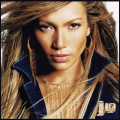
Shown on this page above and below are the many examples of lay Buddhists, including celebrities who wear the collar up style. It is not exactly clear why the collar up style is particularly popular among Buddhists, but it may be from the Mandarin (Manchurian, Nehru collar) stand-up collar style mixed with modern clothing of dress shirts and polo shirts for an East-West fashionable look.
There has been at least one case of a teacher wearing the collar up to please the Buddhists in his community, where it is reported that "He discarded his well-cut Western suit and picked the white turned-up collar top as a concession to the Sinhala-Buddhists" (although most likely referring to the traditional stand-up collar).[1]
-
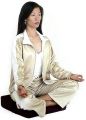
 Meditation position with collar up. Lay Theravada Buddhists do not wear robes during meditation and may wear whatever they like
 -
 Elaine Wynn (a Buddhist) with shirt and blazer collar up
 -
 Goldie Hawn (Buddhist) with polo shirt collar up
 -
-
 Kate Hudson (Buddhist) with coat collar up
 -
 Sharon Stone, actress, fashion model, and Buddhist here with coat collar up
 -

-

-

-

-
 Jackie Chan with collar up
 -
 Jackie Chan with blazer coat collar up
 -
 (Pema Chodron) Some monastic robes include the mandarin stand up collar
 -
 Polo shirts with collar up, have a similar look to the mandarin collar
 -

-

-
-
 Sarah Jessica Parker, a JuBu (Jewish-Buddhist) with shirt and denim jacket collars up
 -
 Cross-legged position with collar up
 -
 Yellow shirt with collar up, kneeling position
 -
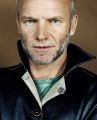 Sting, musician (a Buddhist), with collar up
 -

-
 Walking meditation with collar up
 -
 Buddhist with collar up, next to a Maha Bodhi Temple replica
 -
 Buddhist from Columbia, with collar up
 -
 Buddhist from Indonesia, with collar up
 -
 Buddhist from Sri Lanka, with collar up
 -
 Buddhist in the anjali greeting/pose, with collar up
 -
-
 Buddhist from India with polo shirt collar up
 -

-

-



See Also
Collar up fashion in contemporary society
The collar up style has been popular for many decades, kept in fashion primarily from supermodels, models, and other celebrities who occasionally to frequently wear this style. The origin is most likely from the stand-up mandarin collar from the East. Pictured below are some celebrities (from all religions and backgrounds) who frequently wear the collar up.
-
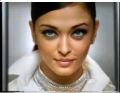 Supermodel Aishwarya Rai (from India) with collar up
 -
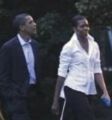 First Lady of the U.S. Michelle Obama with collar up (at back)
 -
 Oprah Winfrey with yellow shirt, collar up
 -
 Oprah Winfrey with white shirt, collar up
 -
 Morgan Pressell with collar up, youngest winner of LPGA (golf)
 -
 Diane Sawyer, host of Good Morning America 1999-2009, with collar up
 -
 Diane Sawyer, Anchor for ABC News from 2009, with collar up
 -
 Finance guru Suze Orman with collar up
 -
 Michael Jackson, King of Pop, with collar up
 -
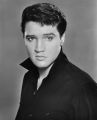 Elvis Presley, King of Rock, with collar up
 -
 Kanye West, musician, with collar up
 -
 Brian Bosworth, former Am. football player, actor, with collar up
 -
 Wendie Malick, actress, singer, model, with collar up
 -
 Jane Fonda, actress, model, political activist, with collar up
 -
 Cybil Shepard, actress, singer, model, with collar up
 -
 Danica Patrick with collar up, godaddy.com spokesperson, first woman to win Indy car race
 -
 Wendie Malick with collar up, at the premier of one of her movies in 2009
 -
 The front cover of Jane Fonda's memoir with her collar up
 -
 Kathie Lee Gifford, tv host, actress, with collar up
 -
 Most fashion sales companies have models wearing the collar up, such as the model shown here from metrostyle, to help sell their products
 -
 Cheryl Ladd, actress, with polo shirt, collar up and buttoned to the top. Polo shirts with collar up and buttoned to top have an especially similar look to the mandarin collar.
 -
 Christiane Amanpour, chief CNN international correspondent 1992-2010, with collar up
 -
 Italian tv host, with collar up
 -
 Morgan Pressel, professional golfer, with polo shirt, collar up
 -
 Actor in a Pepsi commercial, collar up
 -
 Model, with collar up
 -
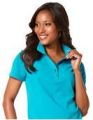 Models frequently pull the collar up in photo shoots to make the product look better
 -
 Justin Bieber, singer, song writer, actor in year 2010, with collar up
 -
 Diane Sawyer, anchor of ABC news since year 2010 with collar up
 -
 Diane Sawyer with shirt closed, collar up
 -
 Sawyer with shirt open, collar up
 -
 Sawyer, collar up interviewing Amanpour who is also wearing collar up
 -
 As anchor, she is one of the most high profile women on television and frequently wears collar up
 -
 Diane Sawyer, with collar up
 -
 Diane Sawyer, with collar up
 -
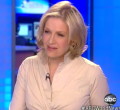 Diane Sawyer, with collars straight up
 -
 Ina Garten aka Barefoot Contessa, chef on Food Network, with collar up
 -
 Close up of 2 collars up, shirt & blazer, with shirt open
 -
 Close up of 2 collars up, shirt & blazer, with shirt closed
 -
 Janet Jackson, musician & actress, with collar up
 -
 Anna Torv, with collar up
 -
 Anna Torv, with coat collar up
 -
 Anna Torv, putting collar up
 -
 Anna Torv, with collar up


Footnotes
- ↑ Asian Tribune. "Buddhist channel article". Retrieved on May 18, 2005.