Mount Kōya
Tibetan Buddhist Encyclopedia is now 14 years old
Our Encyclopedia recently received a wonderful opportunity for a major renewal on its 14th birthday . After many years of growing our Encyclopedia had become bit slow and sometimes even decided not to answer when people knocked on the door.
A very big thank you and blessings to Dmytro Rudiy (rudiy.nl) for his great work in upgrading the server, website and all of the infrastructure and helping make TBE fast and reliable again for everyone!
We kindly ask our readers to help us cover the cost of this important upgrade and also help with the ongoing costs of keeping the Encyclopedia alive and freely available.
 or card
Every little donation helps and every one is deeply appreciated. 🙏🙏🙏
OM AH HUM VAJRA GURU PADMA SIDDHI HUM 🙏🙏🙏
May blessings shower down on all of yous 🙏🙏🙏

Mount Kōya (高野山 Kōya-san?) is the name of mountains in Wakayama Prefecture to the south of Osaka. Also, Kōya-san is a modifying word for Kongōbu-ji (金剛峯寺). There is no one mountain officially called Kōya-san (高野山) in Japan.
First settled in 819 by the monk Kūkai, Mt. Kōya is primarily known as the world headquarters of the Kōyasan Shingon sect of Japanese Buddhism. Located in an 800 m high valley amid the eight peaks of the mountain (which was the reason this location was selected, in that the
terrain is supposed to resemble a lotus plant), the original monastery has grown into the town of Kōya, featuring a university dedicated to religious studies and 120 temples, many of which offer lodging to pilgrims. The mountain is home to the following famous sites:
- Danjogaran (壇上伽藍), a heartland of Mt. Kōya.
- Kongōbu-ji (金剛峯寺), the head temple of the Kōyasan Shingon Buddhism
- Kōyasan chōishi-michi, the traditional route up the mountain
- It also houses a replica of the Nestorian stele
In 2004, UNESCO designated Mt. Kōya, along with two other locations on the Kii Peninsula, Yoshino and Omine; and Kumano Sanzan, as World Heritage Sites "Sacred Sites and Pilgrimage Routes in the Kii Mountain Range".
Access
The mountain is accessible primarily by the Nankai Electric Railway from Namba Station (in Osaka) to Gokurakubashi Station at the base of the mountain. A cable car from Gokurakubashi then whisks visitors to the top in 5 minutes. The entire trip takes about 1.5 hours on an express
train or 2 hours by non-express. Local automobile traffic can be very heavy on weekends until well into the evening. On weekdays however, the mountain offers a
pleasant drive followed by the excitement upon reaching the monasteries lining the summit. Many Buddhist monasteries on the mountain function as hotels for visitors providing traditional accommodation with an evening meal and breakfast.
Images
-
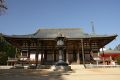 Danjogaran Kondo, the main hall of Mt. Kōya
 -
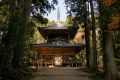 Danjogaran Saito
 -
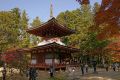 Danjogaran Toto
 -
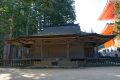 Danjogaran Fudodo (National Treasure)
 -
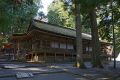 Danjogaran Sano-in
 -
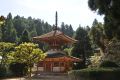 Pagoda of Kongozanmaiin (National Treasure)
 -
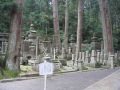 Okunoin Cemetery
 -
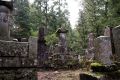 Graves in Okunoin Cemetery
 -
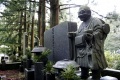 A statue in Okunoin Cemetery
 -
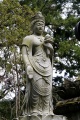 Another statue in Okunoin Cemetery


