Vello Väärtnõu Life (draft)
Tibetan Buddhist Encyclopedia is now 14 years old
Our Encyclopedia recently received a wonderful opportunity for a major renewal on its 14th birthday . After many years of growing our Encyclopedia had become bit slow and sometimes even decided not to answer when people knocked on the door.
A very big thank you and blessings to Dmytro Rudiy (rudiy.nl) for his great work in upgrading the server, website and all of the infrastructure and helping make TBE fast and reliable again for everyone!
We kindly ask our readers to help us cover the cost of this important upgrade and also help with the ongoing costs of keeping the Encyclopedia alive and freely available.
 or card

Every little donation helps and every one is deeply appreciated. 🙏🙏🙏
OM AH HUM VAJRA GURU PADMA SIDDHI HUM 🙏🙏🙏
May blessings shower down on all of yous 🙏🙏🙏

Vello Väärtnõu (also written Vello Vaartnou; known in Asia as Master VanTao, 萬道喇嘛, and to his students as Vanem Taolane, the Elder Taolane; born 17 July 1951 in Kuressaare, on the Estonian island of Saaremaa), Estonian Buddhist of the Nyingma tradition, Geshe of the Ivolginsky Datsan in Buryatia, painter and thangka artist, and founder of the Tibetan Buddhist Encyclopedia, established the first Buddhist community in Estonia, built the first stupas in Northern Europe, founded two series of international academic conferences on Buddhism, and created two online encyclopedias of Buddhism, the second of which has grown into one of the largest free resources on the subject in the world.
He discovered Buddhism at about the age of eleven, in a typewritten book in his grandparents' house, and at seventeen he set out for India on foot. The attempt ended at the Soviet border and cost him three years in a prison camp in the far north. On his return he became a painter in Tallinn, taught himself Tibetan, and made his way to Buryatia, where from 1978 to 1986 he studied under the Hambo Lamas of the Ivolginsky Datsan and his Guru, Munko Lama. In the 1980s he founded the Estonian Buddhist Brotherhood, known as Taola, which translated and copied Buddhist texts, printed thangkas, and between 1983 and 1985 built four stupas in western Estonia, all of this in a state that permitted none of it. Arrested again in 1982 and declared insane as "a mad Buddhist", he went on to initiate the proposal to found the Estonian National Independence Party, the first openly declared opposition party in the Soviet Union, and in February 1988 he was expelled to Sweden.
In exile he exhibited his paintings across Europe, studied in Nepal at Tribhuvan University and under Khenpo Namgyal, and spent eight years in solitary retreat. From 2005 he returned to public work: the first encyclopedia of Buddhism in the Estonian language, the association Estonian Nyingma, the five conferences "Buddhism and Nordland" in Tallinn (2007-2011), and a fifth stupa, ten metres high, at Veltsa. In 2010 he moved to Western Australia, where he founded the ten conferences Buddhism & Australia (2012-2021) and, in 2012, began the Chinese Buddhist Encyclopedia, now the Tibetan Buddhist Encyclopedia, to which he devoted eighteen hours a day. From about 2019 he continued this work in Stockholm, where he also founded the association Swedish Buddhist Studies.
He regarded Buddhism as a field of knowledge rather than a matter of belief, and he held that the Dharma should be available to everyone free of charge. Of himself he said in 2013: "Buddhism is my only passion and addiction; these are the only symptoms I have."[1] When an interviewer praised the scale of what he had done, he answered: "Oh, come now! I am a completely ordinary person."[2]
Saaremaa: family and childhood (1951-1968)
- Main articles: Vello Väärtnõu's Family and Youth in the Estonian Press, 1954 to 2016 - his father Captain Arseni Väärtnõu, his mother Ida and the young swimmer, Women and Smell - Vello Väärtnõu's story of his mother, his grandmothers Viiu and Martha and his childhood, 2010, Kojusõidule ei taha mõeldagi Spordileht, Friday, 6 January 1967
Vello Väärtnõu was born on 17 July 1951 in Kuressaare, on the Estonian island of Saaremaa; during his school years the town bore the Soviet name Kingissepa.[3] He was born into a seafaring family that counted many ship captains and officers of the Republic of Estonia among its members. When the Soviet occupation began, many of them were killed or imprisoned for years.[4] Children on Saaremaa learned early what could be said aloud and what could not.
His mother, Ida Väärtnõu (maiden name Tänav), was a nurse at the local hospital.[5] When Vello started school she gave up nursing and took a job as a cleaner at the Saaremaa road administration, where she worked perhaps two hours a day, "all so that she could spend more time with me". His earliest memory of her was a scent: "She smelled like a birch in spring."[6] His sense of smell remained unusually sharp throughout his life. He would later describe people, prisons, offices and even entire political systems by the way they smelled, and his nose rarely misled him.
The heart of his childhood, however, was his maternal grandparents' home in the countryside. His grandfather, Laas Tänav, was a sea captain and the leading man of Vintri village on the Sõrve peninsula.[5] Vello remembered him standing tall "like a ship's mast" beside his small, beautiful grandmother Viiu. He also remembered him listening to the news in German, English and Swedish, and he spoke Russian as well.[6] The radio, the first battery-powered set in the village, had been bought by Vello's other grandmother, Martha, who lived in her own house fifty metres away. Martha was the mother of Vello's biological father. Born and raised in Germany, she spoke only German, but strangers were told that she came from Belarus, and the boy was carefully coached in the story he was to tell if anyone pressed him. "And I was silent as the grave," he wrote. Martha taught him to count to ten in German before he could do so in Estonian, and for a five-year-old her jams and compotes were reason enough to keep a state secret.[6]
"I was lucky, as I had three grandmothers. But of grandfathers only one alive."[6] He met his biological father only a few times, and the subject was strictly forbidden at home. At his mother's wish he took his surname and patronymic from his stepfather, the sea captain Arseni Väärtnõu, in the hope that the name would help him under the Soviet regime.[7] Arseni, one of seven brothers, was well known among the island's fishermen. The local newspaper followed his career from trawl master in 1954 to captain of the trawler STB-7125 of the "Sõrve Kalur" collective farm, whose crew often led the district; one reporter noted that in his hours of rest the captain's dearest friend was his mandolin.[5]
Other parts of the family's history were spoken of more quietly. His mother's brother, Oskar, had been arrested in 1940 as an enemy of the people. Having already sworn an oath to the Republic of Estonia as a military specialist, he felt he had no choice but to refuse service in the Soviet army. He was sentenced to twenty-five years plus five and sent to the camps of Magadan.[7] Vello looked up to his uncle throughout his youth. He also recalled that one of his grandmother Viiu's brothers was killed by the Chekists in 1940 and thrown, with other victims, into the well of Kuressaare castle. A boy raised on such stories needed little further political education. At school he once openly questioned the textbook account of the Red Army's defence of the Brest fortress, and by his own account his head was shaved as punishment. It would not be the last time the state took an interest in his hair.
In those years, though, he spent most of his time in the water. He trained in the modern pentathlon, sailed, played guitar in bands and played chess, but above all he swam, reaching first place in the Estonian youth rankings.[3][8] Competitive swimming on the island had an unlikely beginning: the cooling tank of the Kingissepa power station, 25 metres by 8, with water at 35 degrees even in winter, which the young coach Toomas Tuuling turned into a swimming school. When the power station shut down, the swimmers were left "on dry land". In January 1967 the sports newspaper Spordileht found Tuuling's group, Vello Väärtnõu among them, training twice a day at the Kalev pool in Tallinn as candidates for the Estonian schoolchildren's team. That August, at the first Suure Tõll games on Saaremaa, he came second in the boys' 50 metres backstroke and third in the breaststroke.[5] "In those years I was actively involved in sport: I measured my life in seconds and centimetres."[9]

It was in the midst of all this sport that he discovered Buddhism. He was about eleven and spending the summer at his grandparents' house. The upper floor was full of books, and among them he found a typewritten copy of Sergei Oldenburg's "Lectures on Buddhism". He read it almost in a single sitting. It was something entirely new to him. He already knew a little about Christianity, since his grandmother was a Christian and always spoke warmly of Christ, but this was different. Roerich and Blavatsky followed. "I became a passionate reader."[9][10] Years later he summed it up more briefly for a Taiwanese reporter: he had been born in a country with no trace of Buddhism, and when he read that book he realised that he was a Buddhist.[11]

The effect of this reading built up slowly and then took hold all at once. At sixteen he decided that something in his life had to change: training the body was not enough, and the mind had to be trained as well. The plan he arrived at was entirely his own. He would travel to India and enter a monastery there, and he would make the journey not by any vehicle but on foot.[9]
Between a boy on Saaremaa and the monasteries of India lay the whole of the Soviet Union and its border. He did not regard this as a serious obstacle.
The first escape, the Komi camp and exile (1969-1972)
- Main articles: Petrozavodsk Prison - Vello Väärtnõu's story of his first morning in prison and at the KGB, 2010, First Day in Prison - Vello Väärtnõu's story of his first KGB interrogation and his first night in Petrozavodsk prison, 2010, Inno ja Irja: Vabadusvõitleja Vello Väärtnõu meenutused Komi vangilaagrist, 20 December 2021
Vello Väärtnõu was seventeen when 1969 began, and the year began badly. In January Captain Arseni Väärtnõu drowned. The notices in the island newspaper speak of an accident and offer condolences to "Ida and Vello"; Eve Pärnaste adds that the circumstances were never explained and that people said the KGB had a hand in it.[5][3]
In June he set out. By his reckoning the road to India ran through Finland, so he made his way to Karelia and tried to cross the border. Instead of reaching Finland he "ended up directly in the hands of the border guards".[9][12] A KGB convoy took him to Petrozavodsk prison, a building dating from the time of Peter the Great to which the communists had added a second floor, and locked him in a "box", a cupboard two metres high and about eighty centimetres wide with a bench inside. "Age 17. A month later I turned 18."[13]
When he wrote about that morning forty years later, he began, as always, with the smell. Soviet prisons smelled the same throughout the country: of sweat, bread, the cell bucket, kirza boots and the guards' uniforms. On entering one, he wrote, a person lost his individuality first of all at the level of smell. At KGB headquarters, the "Big House", where he was taken in handcuffs for the first time in his life, the air was different: "a light whiff of cheap eau de cologne".[13] There he met the investigator Movchan, who studied him in silence for some ten minutes before saying: "Zna-a-achit ta-aaa-k, Vello Arsentyevich - plokhie vashi dela." (So then, Vello Arsentyevich - your affairs are bad.) He was charged with attempting to cross the border, and a charge of treason would probably follow. For treason, the investigator explained, people were shot, and the cartridge cost the state only six kopecks.[13]
The first interrogation lasted all day. The seventeen-year-old explained that he had been raised not by the great socialist homeland but by his mother, two grandmothers and a grandfather, and went on to describe their cooking. Once he realised that grandmothers were a dangerous subject in that building, he changed his story on the spot. There had never been any grandmothers, only a poor single mother who drank out of sorrow at not being admitted to the Communist Party, and a small room in a hostel. To protect his stepfather, the captain, he did not mention him at all, and he claimed to know the others arrested with him barely by sight. Movchan sighed: "Tyazheloe detstvo, a chto podelaesh?" (A hard childhood, but what can you do?) It did not occur to the boy that there were no such hostels on Saaremaa, or that the Estonian KGB would supply a full account of his short life. The lesson stayed with him: "There would have been no point at all in telling them anything; rather it would have been useful simply to keep silent."[7]
Late that evening he was taken to the first cell of his life. One of its two occupants, Sergei, who was serving his third sentence and had been brought from a camp at Vorkuta, calmly and methodically explained how prison life worked. In him, as Vello later wrote, the Taolane found "his first prison guru". Before they slept, Sergei gave his verdict: "Takie kak ty ne propadut tut v etoi sisteme!" (People like you will not perish in this system.) The next morning the other cellmate, a heavily built first-time prisoner, tried to make the newcomer carry out the cell bucket. Vello picked up the aluminium teapot from the table and settled the matter with it. The prison governor gave him five days in the punishment cell, the maximum allowed before trial, and warned him that heroes who started out this way usually ended up in the cellar facing a firing squad. "So passed my first day in prison."[7]
The Supreme Court of the Karelian ASSR in Petrozavodsk sentenced him to three years in a prison camp, which he served in the Komi ASSR in the far north.[3][14] His own summary of those years can hardly be bettered. The main characters, he wrote, were "me, the Chekists, the prisons, the prisoner-transport wagons, the camps far in the North, the taiga, wolves, machine guns in the towers surrounding the camp, sheepdogs", along with punishment cells, transit prisons and "the learning of languages".[13] The prisoners were building the great homeland in return for a crust of bread, cabbage water and three roubles a month. During the February snowstorms wolves tried to climb over the barbed wire, and the convoy commanders joked that they were not guarding the prisoners but protecting them.[15]
He was not a quiet prisoner. The camp's regime chief wanted to be known as "the Terror of the Camp". Vello instead nicknamed him Lojus, an Estonian word for a head of cattle and, by extension, a brute. The whole camp adopted the name, and its author was given fifteen days in the punishment cell. When the officer threatened to put a bullet in the back of his head, Vello pointed out that he would first have to get behind him, and that in such situations a weapon can quickly change hands. "For a Buddhist this was a harsh statement," he later admitted, "but I had to help him find his own self."[15]
One winter his mother came to see him. Ignoring his written instructions and the advice of the entire family, she flew to Moscow and took the train through Kotlas to Mikun with two suitcases of food and woollen socks. She stepped off the train into a snowstorm, sank waist-deep in the snow, and was saved from freezing only by the station's ticket seller. A tracked vehicle carried her the last five kilometres to the camp gate, where the Vana Tallinn liqueur she had brought won over the guards and even the camp commandant. Then the regime chief walked in. He taunted her for two hours and sent her away without letting her see her son or leave him so much as a pair of socks. Summoned to headquarters to hear about it, Vello replied: "A man who insults another man's mother is not a man but a Lojus". He was dragged feet first through the snowdrifts to another five days in the punishment cell. That night two men from his barrack, a Lithuanian and a prisoner named Velichko, made their way through the blizzard and passed garlic and pork fat through the window, both of which were worth their weight in gold in that camp. Back on Saaremaa his mother lay ill with fever for a week, nursed by Martha and Viiu. It was Uncle Oskar, who knew the camps from his own years in Magadan, who finally calmed the weeping women. When the boy came home, he told them, he would have passed the hardest examination of his life, and nothing in this world would break him again. "On that point he was right."[15]
The camp was also his first university. Among the prisoners was an elderly man named Chaikin, a former lecturer at the higher courses of the Moscow Military Academy, who one day had tired of lying and begun to teach the true history of the USSR. He had been beaten for two years in the Lubyanka and, like the Estonian Forest Brothers held in the same camp, had no fixed term; his sentence was simply extended every five years. Chaikin taught Vello English and the history of the Cheka. "They were the first political gurus for me." When a friend in Tartu recommended Solzhenitsyn to him years later, he felt little interest, having already heard it all at first hand. "I think that doing time in the North made me an enemy of the Soviet system and of the communists on a conscious level."[13]
After the camp he was sent into exile still further north, and in June 1972 he was released.[13][3] He was twenty years old. He had left home in search of a monastery in India. He had found instead the taiga, a handful of teachers no one would have chosen, and the certainty that he and Soviet power would never be reconciled. Looking back in 2010 on the boy who had answered the investigator so cheerfully, he added a single line: "In those days I did not think like that."[13]
Art and searching: Suure-Jaani, Tallinn, the Art Institute, astrology, Leningrad (1972-1980)
- Main articles: About Vello Väärtnõu, 13 September 1991 - Eve Pärnaste, Vello Väärtnõu in the Estonian Art and Architecture Biographical Lexicon (EKABL) - his five group exhibitions in Estonia, 1980 to 1982, Tibet in Estonia - Tarmo Teder “Existentia 3” p 38-41, 1985, The Turtle Shell (Kilpkonna kilp) - Vello Väärtnõu's writing on Buddhist astrology (complete text)
Vello Väärtnõu returned to Estonia in June 1972, but he could not go home. Saaremaa lay in a border zone, and a man with his record was not permitted to live there. He recalled being allowed eighteen hours with his mother before he was sent off the island. He settled in Suure-Jaani, on the mainland.[3][9]
There he was kept well away from Tallinn. He worked at the Lahmuse state farm and then as a stoker in the gardens of the Paala collective farm; by his own account he was also an excavator operator, a tractor driver and a machine operator.[16][9] He drove in rallies and played music.[5] That summer he painted his first pictures, and within a single year he completed the last two grades of secondary school by correspondence.[3] The boiler house became his first lecture hall. Friends gathered there to discuss astrology, art, Christianity and Buddhism, while the stoker himself read and drew constantly.[16] He later said that he was making up for the years lost in the north by studying philosophy, languages and history, and that even then all his reading led in one direction: towards Buddhism.[17]
He then moved to Tartu, intending to study history at the university. The dean assured him that he would not be admitted as long as he, the dean, remained in office, and that there was no point in trying.[3] He was told that with a "track record" like his, as a former convict and an enemy of the Motherland, he would never receive a higher education anywhere in the country.[9] He stayed in Tartu all the same, studying drawing in Kaljo Põllu's art class and making his first prints there.[3]
Before long he was in Tallinn. The graphic artist Alo Hoidre invited him to work at the State Art Institute, where he studied graphic techniques under the master Aleksander Sarri from 1973 to 1978. From 1974 to 1980 he also learned painting from his friend, the artist Jüri Arrak.[3] He never set much store by this training. "I am self-taught. I have learned most in my own studio," he said in 1990. He acknowledged that he had practised printmaking "very diligently" under Sarri and had learned painting techniques from Arrak, but he did not believe that anyone needed to study art at a school.[18] He once told a Kyiv journalist that the future painters had been sent out to the villages to draw cows and dig potatoes; she concluded on his behalf that an artist's spirit cannot be fed on cows alone.[19]


His real nourishment came from the East. His study of Buddhist and Taoist philosophy led to a passion for Eastern art, especially Chinese painting and literature of the 16th century and the art of old Japan. He translated classical treatises on Chinese art from Russian, and within Chinese religion he was drawn above all to the mystical Taoist school of the "White Lotus".[3][17] He travelled to Leningrad, where he met orientalists and "a great many interesting people", among them Evgeny Torchinov, who was just beginning work on his "Introduction to Buddhism".[9] His long friendship with the Leningrad painter Gleb Bogomolov, one of the first avant-garde artists in the USSR, also belongs to these years.[3] Writing in 1985, Tarmo Teder dated Vello's commitment from the year of his return: since 1972 he had been "a man dedicated to Buddhism", who spent a decade acquiring, studying and systematising articles, books, manuscripts, albums and catalogues.[20] The encyclopedist was already at work. All he lacked was an encyclopedia.
He made no secret of his convictions. According to Marju Broder, he was the only person in socialist Estonia at that time who publicly called himself a Buddhist.[8]
In the mid-1970s he took up astrology as well. After meeting the astrologer Igor Mang he taught himself the rest from books, and he went on to found the Estonian Astrology Society, an organisation about as welcome in the Soviet Union as a Buddhist monastery.[21][3] In the early 1980s he lectured on astrology and Buddhism at Jüri Arrak's studio in Tallinn to what he later described as a great number of interested people.[17][22] Astrology remained with him for life. He regarded it as a Buddhist science and a practical tool: the right moment to begin building a stupa is calculated, not guessed. Many years later he set out his understanding of the subject in The Turtle Shell, and as late as 2025 an Estonian film critic still referred to him simply as "the astrologer Väärtnõu".[23]
By now he was gaining recognition as a painter. He had started out with abstract works, "but they did not want to get through at exhibitions", so he turned to figurative compositions and landscapes.[24] In 1979 he was admitted to the Youth Association of the Artists' Union, and the following year the art historian Sirje Helme wrote about him in the magazine "Noorus" as a landscape painter of great promise.[3] Between March 1980 and November 1982 his work appeared in five group exhibitions of young artists in Tallinn and Tartu, and in the early 1980s his paintings were shown at the world exhibition in Tokyo.[25][3] A promising career as a Soviet Estonian artist lay open to him. It held little appeal.
Throughout these years another plan had been quietly taking shape. Buddhism had reached Estonia once before, through Karl Tõnisson, the barefoot monk, but that tradition had been broken, and as early as the 1970s Vello wanted to restore it. His own allegiance was to the Nyingma, the ancient school of Padmasambhava. There was, however, no Nyingma monastery anywhere in the USSR. The only way in was through the Gelug school, and its monastery stood far to the east, in Buryatia.[17] He learned only quite late, in Leningrad, that a functioning Buddhist monastery existed in the Soviet Union at all.
"I left the institute in order to go there."[9]
Ivolga: the Buryat lamas (1978-1986)
- Main articles: Ivolginski Datsan by Marju Broder, Relations with the Ivolga Monastery in Buryatia, Letter of the Ivolginsky Datsan "Khambin Sume" about Vello Väärtnõu and Estonian Nyingma - Dagba Lama (D. D. Ochirov), 4 March 2011, Lubsan Samdan Tsydenov, Bidia Dandaron and The abbot of Kumbum by Vello Vaartnou

Vello Väärtnõu arrived at the Ivolginsky Datsan in Buryatia, the seat of the head of the Soviet Union's Buddhists, with a simple request. He went straight to the monastery and asked the monks whether he could stay there for good and study. He was turned away at the gate.
"'Get out of here!' said the monks. 'Why?' I asked them." The answer was that the Soviet authorities allowed no one but Buryats to become monks. He wandered around Buryatia for a few days and then went back to Estonia, where he spent the whole of the following year over his books. It was then that he began to teach himself Tibetan.[9]
A year later he returned and informed the monks that this time he was not going anywhere. They put up with him for three months and then let him into the datsan, even though his presence there was illegal.[9] The monastery's own record, a letter signed by its head in 2011, states that he studied at Ivolga from 1978 to 1986 under two teachers, Pandito Hambo Lama Zhimba Gjamtso Erdineev and Pandito Hambo Lama Munko Tsybikov, who led the Buddhist community of the USSR "in quite hard times".[26][27]
Munko Lama became his Guru. He was a physician, and he hoped to make a physician of his Estonian student too. Vello had no gift for medicine and no interest in it. "Guru told me that philosophy cannot heal the body, while I said that the mind is more important than the body."[28] The argument lasted three years, until Munko Lama accepted that no doctor would come of him. In the meantime Vello was studying philosophy and logic with the Hambo Lama.[9]
He later told several stories about those years, and in most of them the joke is on himself. During his first summer he was waiting for the bus to Ulan-Ude when an old woman asked him whether he was a lama. He mumbled that he had only come to study. She remarked that he had been clever enough with Munko Lama, but that once outside the monastery he was wrapped in ignorance again. On another occasion he presented Munko with a study plan covering about thirty years. Munko replied that it would not work, because with some people the mind ends up buried under knowledge and the person can no longer be found beneath the heap. Vello suggested that there might be a way of removing the barriers of knowledge. "The next day I marched to my first retreat behind Munko."[29]
After he had been at Ivolga for some years, and felt sure of his ability to judge people, Munko told him one evening that a new teacher would arrive the next day. In the morning, making his usual three rounds of the monastery, Vello passed a man in a dirty coat asleep under the prayer wheels and took him for a drunkard who had wandered in. When he reached Munko's house to meet the famous teacher, he found Munko drinking tea with the same man. "He became my best teacher in philosophy for many years and my closest rootguru Zimba."[29]
It was Zimba who once took a vajra from his pocket, let his student handle it, and threw it a few metres into the grass with the instruction to bring it back. Vello had seen exactly where it fell. He searched the grass with his eyes and then with his hands, in wider and wider circles, and found nothing. Zimba got up from the bench, picked the vajra up from right in front of his student's nose, and said, "so much about the philosophy and sansara".[29]
He studied philosophy, logic and the texts; Vasubandhu's Abhidharmakosha he worked through with Baasan, a Mongolian friend who often came to the monastery, in sessions so absorbing that their landlady once asked whether the two of them were already in Nirvana, since they no longer knew how to say hello.[29] He travelled back and forth to Buryatia constantly, staying for months at a time, and repeatedly visited the holy mountain of Alkhanai.[17] He completed his studies with the title of Geshe, the first Estonian to hold it.[30]
Ivolga was a Gelug monastery, and its Estonian student never pretended to be anything other than a follower of the Nyingma. "I studied Gelug but I have always counted myself as Nyingma. In Ivolga monastery, there were jokes about Nyingma spies in the Gelug monastery."[28] His teachers took it with good humour. In the datsan he was nicknamed "Guru Rinpoche", because when he read the texts aloud he replaced the name of Tsongkhapa with that of Padma.[17]
Asked what it had meant to him then to be a Buddhist, he answered that it meant above all possessing knowledge, especially of Buddhist logic and philosophy. Nirvana and enlightenment still seemed abstract and far away; what changed, gradually and powerfully, was his whole view of life. Then came the next step. "Sometime around 1983 I realized that the time had come to begin practising Buddhism in earnest, independently."[9]

He never stopped speaking of his teachers. Decades later, in Australia, he still explained the stupa in Munko Lama's words, and of his late Guru he said simply that he hoped he had reached Pemakö.[28]
-
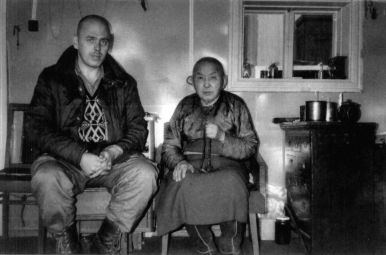 Vello Väärtnõu with Hambo Lama Zhimba Erdineev at Ivolga.
-
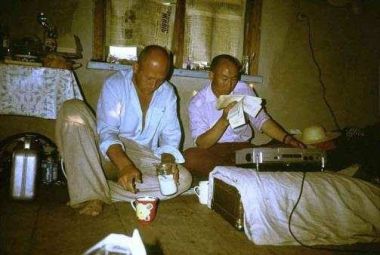 Vello Väärtnõu and his Mongolian friend Baasan studying texts at Ivolga.
-
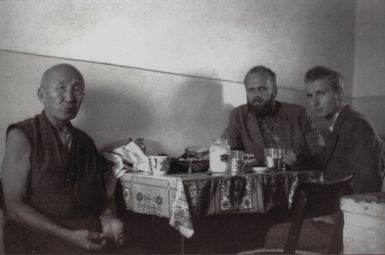 Munko Lama with the artist Jüri Arrak and Siim Jõesaar, who visited Ivolga with Vello in the early 1980s.


Taola, the Estonian Buddhist Brotherhood, and the first stupas of Northern Europe (1982-1988)
- Main articles: Estonian Nyingma, The first Estonian Buddhist Brotherhood, Activities of the Buddhist Brotherhood, Building the first stupas of northern Europe in 1983–1985, Translation and the publishing of Buddhist books and texts by Taola, The Estonian Buddhist Brotherhood (Taola), 1983-1988 - Vello Väärtnõu's talk in St Petersburg, 2007, Kife: The Lives and Dreams of Soviet Youth (1989) - Vello Väärtnõu and the Estonian Buddhists, Do You Doubt Me? - A Buddhist Clairvoyant Wonder from the Estonian Brother Republic - Finnish magazine article by Harri Sirola

Vello Väärtnõu founded the first Buddhist community in Estonia in the same matter-of-fact way in which he did most things. As he told it, "it was 1983. One day I met a friend of mine and suggested that we practise Buddhism together. My friend agreed. Over the following months about eight of us gathered."[9][31]
The Estonian Buddhist Brotherhood soon became known by a shorter name, Taola. Its members were called taolased, and their teacher was the Vanem Taolane, the Elder Taolane. The Brotherhood lived and worked in the Kadriorg district of Tallinn, from 1984 in a flat on Leineri street.[17] The first taolane was Arno Arrak, the son of the artist Jüri Arrak, known in the house as Mõmmi. He was followed by Jüri Saard and Tõnis Promet, and later by Boris Saabas, Peep Paasian and Peeter Kaasik. Around this core stood the supporters, who lived in their own homes and did much of the translating: Tiina Hallik, Anu Rootalu, Enn Jaanson, Eve Pärnaste, Siim Jõesaar and others, with Ants Luik, and later Eke-Pärt Nõmm and his father Jaan Nõmm, lending a hand.[17] "It is curious that in our Buddhist brotherhood there were three times as many women as men," Vello observed. "They translated books, copied them, bound them, and did many other important things, and were a great help."[9]
Taola supported itself. Its members worked as boiler-room stokers, a common occupation among the Soviet Estonian intelligentsia, and the money they earned paid for materials and for their keep.[17] Vello lectured to them on Buddhism and sent them to English courses; independent study, he liked to say, was always "compulsorily popular". Tibetan and Old Mongolian were taught by the linguist Pent Nurmekund, founder of the Oriental Studies cabinet at the University of Tartu, who came up by bus and refused all payment. The taolased called him the Professor. Seeing how thin his blue jacket was, they bought him a warm down jacket. He was persuaded, with difficulty, to accept it, and arrived for the next lesson in the old one. He had sold the present, he explained with dignity, and bought books.[17]
The work was translation, copying and the making of sacred objects. The Brotherhood translated eighteen books and dozens of articles and sutras from English, Russian, German and Finnish, and copied more than forty books in hundreds of copies.[30] Friends from abroad carried in Buddhist literature by the suitcase, and most of the Tibetan texts came from Buryatia.[17] Vello also compiled the first Tibetan-language textbook in Estonian. It was never published; it passed from hand to hand, and the records were confiscated by the KGB during a search.[9]
In the same rooms the taolased printed thangkas by silkscreen, beginning with Avalokiteshvara and White Tara, painted khadags, made small Buddha statues (burkhans) and produced incense.[9] Everything they produced was also taken to Buryatia, where such things were no longer made and were eagerly awaited in the monasteries and among the faithful. It was all given free of charge. Vello held throughout his life that work done for the Teaching must not be paid for.[17]
The traffic ran in both directions. Every member of the Brotherhood made the journey to Ivolga, and the old lamas of the datsan in turn visited Estonia regularly until 1988.[28][17] These visits were kept quiet. Even within Taola few knew the full extent of the dealings between Vello and the monastery, since the authorities would have made the datsan suffer for them.[17]
-
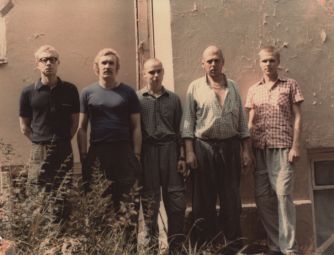 Taola in the 1980s: Jüri Saard, Enn Jaanson, Tõnis Promet, Vello Väärtnõu and Arno Arrak ("Mõmmi").
-
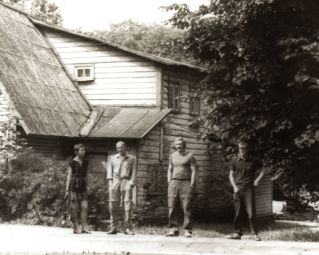 Taola at the flat on Leineri street, Kadriorg, Tallinn.
-
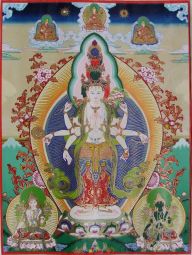 Avalokiteshvara, one of the first silkscreen thangkas made in Taola.
-
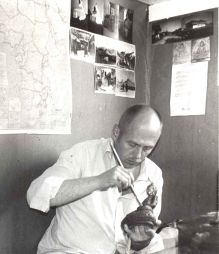 Vello Väärtnõu making a Buddha statue in Taola.
-
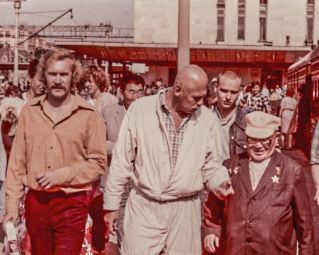 Lama Dugarzab of Ivolga at the Baltic Station in Tallinn, 1980s.


The stupas
A Buddhist tradition, as Vello understood it, begins with a stupa. The first was raised under his direction in 1983 at Pangarehe, the summer home of Jüri Arrak on the west coast. Jüri, Urve and Jaan Arrak and the writer Jaanus Tamm took part in the building, and the upper part, which symbolises the heavens of Brahma, was made by the folk healer known as Vigala Sass.[17][20] In 1984 the Brotherhood built a second stupa, about six metres high, in Tuuru village near Haapsalu, on farmland belonging to Siim Jõesaar.[20][17] Two more followed beside it in 1985, one dedicated to Mahakala and one to Padmasambhava.

These four were the first stupas in Northern Europe, and the only ones built outside a monastery anywhere in the Soviet Union in Soviet times.[30] Soviet law permitted neither religious buildings nor the copying of religious books. Vello said that the only protection his stupas had was the rituals performed for them and the astrologically correct moment chosen for the start of each one.[17] An American journalist who met him recorded that plain-clothes KGB men drove out to look at the stupas and ordered them torn down. Vello refused, and since they stood in a private garden there was little more the KGB could do.[32] They are standing today.
"So in total, in those years, I built four stupas. That is how Buddhism got going in full swing in Estonia!"[9]
-
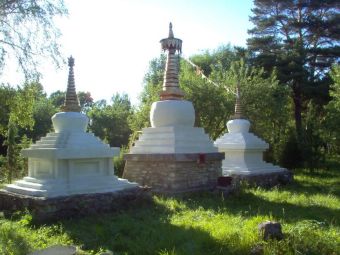 The three stupas at Tuuru village near Haapsalu, built in 1984 and 1985.
-
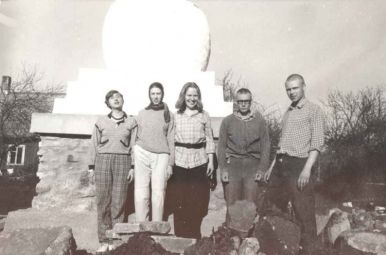 Members of Taola building a stupa.
-
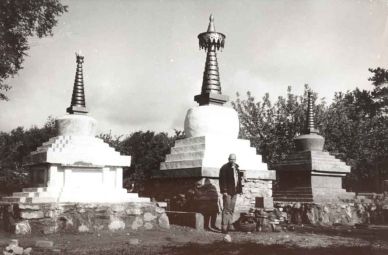 Vello Väärtnõu at the Tuuru stupas.


The monastery that was planned
The Brotherhood was only the first part of a larger design. Vello intended to found a Nyingma monastery in Estonia where a full Buddhist education could be given, to send Estonians to study in Asia, and in time to see learned lamas return home.[17] He spent eight months looking for the right site according to the rules of geomancy and found it at the Kaasiku farm in Veltsa, in Pärnu County.[33] The farm was bought in 1987. The architect and artist Leonhard Lapin drew up the plans for the monastery in 1988, the first project of its kind in Estonia.[17] A petition for permission to open a Buddhist temple, signed by twenty believers, had already been refused.[32]

The monastery was not built. The events of 1988 intervened, and the stupa at Veltsa had to wait twenty years. What the Brotherhood did achieve in its six years was summed up by Marju Broder: Vello and his companions "built a touchable, visible body of Buddhism" in a country that had none.[30] His own verdict was shorter. "It was a happy time for me."[28]
Karelia 1982, Patarei and the "mad Buddhist" (1982-1983)
- Main articles: Vello Väärtnõu Arrested in Karelia in 1982 and Held as a Political Prisoner - reports in the Estonian exile press, 1983 to 1986, New Imprisonments in Estonia - Meie Elu 1983-03-31 Urb and Vaartnou arrested in Karelia

Vello Väärtnõu had not given up the idea of leaving. On 5 November 1982, at 14:35, he was arrested at Kalevala in the Karelian ASSR, near the Finnish border, together with the singer Tarmo Urb. The Soviet case papers record the decision, taken that same day, to place him in custody.[34] According to Urb, the plan had come up almost by chance in a conversation between the two of them.[35]
He was held first in Petrozavodsk, for the second time in his life, and then in Patarei prison in Tallinn. There he turned his cell into a classroom and had his cellmates take notes. "I lectured them on the three world religions: Buddhism, Christianity and Islam. The lads busied themselves diligently, though hardly that they understood anything, but there was order in the house."[18] Astrology and Tibetan folk tales, it was said, were especially popular with the prisoners.[17] Vello recalled that he refused to speak to the investigator and wrote out a renunciation of his Soviet citizenship.
The authorities found another solution. A commission headed by the psychiatrist Professor Jüri Saarma declared him a severe schizophrenic.[3] Vello had been saying for years that he would one day head the first Buddhist monastery in Estonia, which made the commission's task easier: a man who wanted to found a monastery in the Soviet Union was plainly mad.[17] "In prison I was given a schizophrenia diagnosis 'in my own interest': a mad Buddhist."[18] He spent six months in the psychiatric department of Patarei and was released in May 1983, after a further month in a Tallinn psychiatric hospital.[36][3] Throughout these years the Estonian press in exile reported on him as a political prisoner.[34]
When he came out, he learned that he had been expelled from the Youth Association of the Artists' Union. The official grounds were unpaid speeding fines and conduct unbecoming a Soviet artist. Exhibitions in Estonia were now closed to him.[3] He took the loss calmly. "When I got out, the number of my acquaintances had decreased remarkably. Luckily I thus found out who my friends were."[18]
With his career as a Soviet artist over, nothing stood between him and his real work. The Brotherhood, the translations and the stupas all belong to the five years that followed.
The ERSP proposal, the Moscow press conference and the expulsion (1987-1988)
- Main articles: Foundation of Estonian National Independence Party by Väärtnõu, My Story: the ERSP, the Drive to Moscow and My Expulsion - Vello Väärtnõu's own account, The Wall Breakers: The Story of MRP-AEG and the ERSP (Viktor Niitsoo, 2002) - Vello Väärtnõu and the Proposal to Found the ERSP, In Soviet Baltic, an Unintended Openness - The New York Times, Wednesday, 10 February 1988, Vello Väärtnõu Detained, Searched by the KGB and Expelled - reports in the Estonian exile press, January to April 1988

Vello Väärtnõu entered politics in the autumn of 1987 and left it, involuntarily, less than six months later. That autumn he had applied once more for permission to study Buddhism in India and had been refused.[37] On 7 November he spoke at a mass rally in Pärnu, where the crowd was complaining about shortages. He told them that "we needed to make our own sausage and bread ourselves rather than beg others for it", and that to do so "we needed to create our own state, an independent state".[9]
In December he proposed to Eve Pärnaste that they found a party, and by Christmas he had drafted its first programme with the help of Tiina Hallik, Anu Rootalu and Pärnaste, all of them from Taola.[17] On 21 January 1988 fourteen people, Vello first among them, signed the proposal to found the Estonian National Independence Party (ERSP).[3] A few days later he drove to Moscow with Ärvi Orula and Eke-Pärt Nõmm. The car was stopped and searched on the way, but the papers, hidden in a coffee thermos, were not found.[37] By his own account he handed the document in at a government office, where an official went pale and a lawyer warned him that this smelled of prison. "I snapped back at him that I had already sat, so the experience was there."[38]
On 30 January the three presented the proposal to foreign correspondents at a press conference in a Moscow flat. It was broadcast the same evening by the Voice of America and Radio Free Europe, and on 10 February The New York Times reported on it under the headline "In Soviet Baltic, an Unintended Openness".[39] The historian Viktor Niitsoo has called it the first initiative to found an openly active opposition party in occupied Estonia and in the Soviet Union as a whole.[37]
The KGB responded quickly. On 6 February it carried out searches. Vello was first offered a choice between psychiatric "treatment" and leaving the country; a few days later it turned out that the diagnosis of schizophrenia had been withdrawn, and the choice became prison or emigration.[3] On the morning of 11 February KGB officers came to his home in Tallinn and told him that he was being expelled on the personal order of Gorbachev.[9] He was flown to Moscow, where the Swedish embassy issued him a visa on the spot, and on 13 February 1988 he landed in Stockholm together with Eke-Pärt Nõmm.[40] His wife Natali followed on 2 April.[41]
At Arlanda airport some twenty Estonian exiles were waiting with small blue, black and white flags, full of pity for the repressed man whom the Soviets had even shaved bald. "I had to disappoint them: I have been hairless for a long time because of Buddhism, not because of opposition to the state."[18]
He was thirty-six. As a boy he had been sent to a prison camp for trying to leave the Soviet Union; now the Soviet Union had bought him the ticket. Looking back, he said that politics had never particularly interested him, and of his manner in those months he remarked: "Yes, in those years I really was rather aggressive!"[9] The party he had proposed was founded in August 1988 without him. Taola's first team was scattered, the monastery at Veltsa remained a drawing, and the Vanem Taolane began again in Stockholm.
-
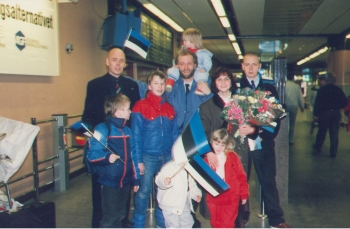 Vello Väärtnõu (left, in the black suit) at Arlanda airport, Stockholm, 1988.

Exile: Sweden, exhibitions, return visits (1988-1993)
- Main articles: Vello Väärtnõu in the Estonian Press, 1989 to 1998 - exhibitions, return visits and remembrance, Vello Väärtnõu - Leebe brutaal, Vello's New Life in a Two-Room Flat in Akalla - Prisoner in Siberia and Monk in Mongolia - Ny i Sverige 4/1989, I Will Be Sure of Coming Back Only When I Am Here Again - Estonian artist Vello Väärtnõu left on a car journey to his homeland - Monday, 19 June 1989, Astrology lecture by Vello Vaartnou at the Russian Club in Stockholm - flyer, Friday 5 June, Art of Vello Vaartnou - gallery of paintings, Buddhist art and exhibitions

Vello Väärtnõu spent his first month in Sweden sleeping on a sofa in the office of the Estonian House in Stockholm and walking around the city by day. When he tired of this he went to the social services office and explained his situation, and he was given a flat the same day. "It stunned me how quickly this procedure went here in Stockholm."[38] Sweden had granted him political asylum at once; according to a later Swedish ambassador, he was the only person in the country's history to receive a residence permit and citizenship in fifteen minutes.[42] He attended a Swedish language course for one month, decided that the language was easy enough, and went into town to practise on the local citizens.[38]
He kept his distance from émigré politics. "Estonia's future is being built in Estonia; from Sweden it is difficult to influence it. That is why there has been enough time left for making art."[43] He had begun painting again almost immediately. His first exhibition in exile opened in a Stockholm gallery at the end of May 1988, little more than three months after his arrival. The pictures had been painted in a hotel room where the free space between the two beds measured a quarter of a metre.[3]
In 1989 a Swedish magazine found him in a small two-room flat on the top floor of a block in Akalla, a suburb of Stockholm, moving between paint pots and canvases while the summer went on outside. He was, the reporter wrote, living a monk's life in exile, and as a refugee he could for the first time do what he wanted: paint undisturbed.[44] Free of the Soviet Artists' Union and its preference for realism, he returned to abstraction and painted more intensively than ever.[3]
The exhibitions followed one another quickly: Munich in the autumn of 1988, Zurich in February 1989, the Vaasa museum in June 1989, West Berlin and Frankfurt am Main in December 1989, Helsinki in May 1990, Tallinn and Leningrad in September 1990, Mälargalleriet in Stockholm from December 1990 to January 1991, and Tartu and Strängnäs in 1991.[3] At Vaasa, in an exhibition of Soviet artists called "Glasnost", most of the works were his. They recorded his first sixteen months in the West under titles such as "As an Emigrant in Sweden", "Two Monks and a Transvestite" and "Arlanda Airport". Collectors had begun to buy, and one of Sweden's best-known art dealers had acquired a large number of his paintings and ordered more. "I think I will do as well in art as in politics," he told a Finnish reporter.[43]
That interview was given in Helsinki in June 1989, on the eve of a journey he could not be sure of completing. Sixteen months after his expulsion he had obtained a tourist visa, and he set off by car across the Karelian Isthmus to see Estonia again. Asked whether there was any guarantee that he would be allowed back out, he replied that there was none at all. "I will be sure of getting back only when I am here again."[43] He did get back, and for the next three summers he spent long periods in Estonia.[3]
In the autumn of 1990 his paintings were shown in Tallinn again, at the G Gallery. The Saaremaa newspaper proudly announced an "Exhibition of an artist from Saaremaa" and noted the island's junipers among his subjects, and the following spring his work was on sale in Tartu.[45] During these visits he gave the interviews in which he looked back on prison, Buddhism and his art, among them the conversation published under the title "Leebe brutaal" (The Gentle Brute).[46]

In Stockholm he remained what he had been in Tallinn: a painter, an astrologer and a Buddhist. He lectured on astrology at the city's Russian Club, read enormously, and kept to himself.[47][38] Estonia regained its independence in August 1991, but he did not move back. He had other plans, and they were older than any of his politics. "I had dreamed of India since childhood, and wanted very much to go there, but I understood that I first had to earn some money."[9]
-
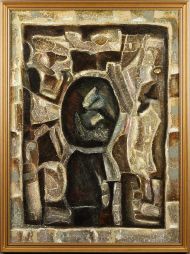 Vello Väärtnõu, "Composition", 1989, oil on canvas, 115 x 84 cm.
-
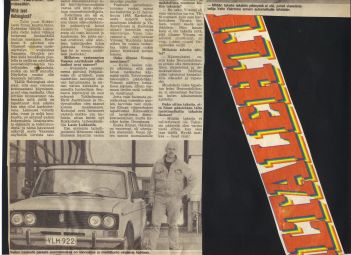 June 1989: Vello Väärtnõu in Helsinki before driving to Estonia for the first time since his expulsion. Read the translated article.
-
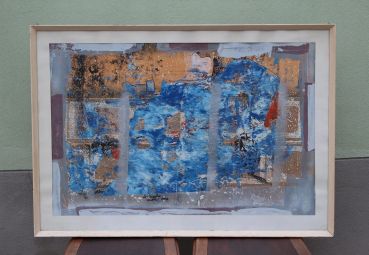 Vello Väärtnõu, "Castle", 1990, 102 x 72 cm.


The Himalaya and the years of retreat (1993-about 2005)

Vello Väärtnõu reached the Himalaya a quarter of a century after he had first set out for it. Once he had earned enough, he left for Asia, going first to Nepal. In Kathmandu he studied at Tribhuvan University and then at a Bhutanese monastery.[9] For five years he was the private student of the monastery's abbot, Khenpo Namgyal.[42] After Ivolga, where a Nyingma practitioner had studied among the Gelug, he was at last learning within his own tradition.
It is the least documented period of his life. Only his painting surfaced from time to time: in June 1997 an exhibition of his work opened in Kyiv, where a local journalist introduced him to her readers as "The Picturesque Islander".[48]
From Nepal he returned to Sweden, and there he withdrew altogether. "For the following eight years I lived alone, engaged in Buddhist practices, in other words, I arranged a solitary retreat for myself. I was alone, without any retreat assistants."[9] He was by then in his late forties. He had studied Buddhist philosophy for more than twenty years, under teachers in Buryatia and Nepal, and he now did what Munko Lama had once shown him was the remedy for a mind buried under knowledge.
When he emerged, in about 2005, he had a great deal of work planned.
Estonian Nyingma, Veltsa and "Buddhism and Nordland" (2005-2011)
- Main articles: International Conference Buddhism and Nordland 2007-2021 - history, and the Estonian Wikipedia article "Budism ja Põhjala", Buddhism and the Nordland 2007 - the text of the film about the first conference, Tallinn University, 21 and 22 February 2007, Estonian Nyingma in 2007 - the presentation of Estonian Nyingma, the conference Buddhism and Nordland and the history of Taola, October 2007, Drive to the Countryside! 33 - ETV, 28 November 2009 - Vello Väärtnõu and the Little Tibet at Veltsa (VIDEO), A Buddhist Park Comes to the Land of the Estonian Prophet - Maaleht, Thursday, 16 July 2009, Welcoming Speech by Vello Väärtnõu in the 8th Conference of the United Nations Day of Vesak, Pärnumaa Buddhists Gave the Thai Princess a Thangka Made by Vello Väärtnõu - Anu Jürisson, Pärnu Postimees, 29 June 2011, Karl Tõnisson, Agvan Dorzhiev, Dza Lama and Baron Ungern - Vello Väärtnõu's paper at the Agvan Dorzhiev Readings, St Petersburg, 11 November 2006

Vello Väärtnõu resumed his public work in 2005 with a project that could be carried out from a desk. He began to compile the Estonian Nyingma Encyclopedia of Buddhism, the first online encyclopedia of Buddhism in the Estonian language, which eventually grew to more than 3,200 articles.[42][30] It gathered articles and explanations from many different points of view, and when readers asked why it did not present a single one, his answer was that a reader who meets different ideas develops his own thinking and forms his own understanding.[42]
The second project was a conference. The idea of bringing together scholars of the Buddhism of the northern countries had been with him since the 1970s. In November 2006 he presented a paper on Karl Tõnisson, Agvan Dorzhiev, Dza Lama and Baron Ungern at the Dorzhiev Readings in St Petersburg, and on 21 and 22 February 2007 the first international conference "Buddhism and Nordland" met at Tallinn University.[49][50] That spring the association Eesti Njingma (Estonian Nyingma) was registered to continue the work of the Brotherhood of the 1980s. Marju Broder, who had become his closest co-worker, served as secretary of the conferences.[50]
"Buddhism and Nordland" was held five times in Tallinn, in 2007, 2008, 2009, 2010 and 2011. The second conference was devoted to Baron Roman Ungern von Sternberg, and the third was accompanied by an exhibition of the books that Taola had translated and bound by hand in the 1980s. In five years the conference grew from three participating countries to fourteen and from eight lecturers to twenty-two; more than a hundred papers were published and made freely available online.[51][42] Lamas from Ivolga took part every year. In 2011 the head of the datsan wrote that the monastery valued its cooperation with Estonian Nyingma, and recalled that Vello Väärtnõu had studied there under two Hambo Lamas.[52]
-
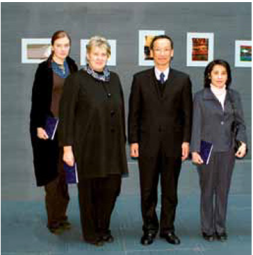 The Thai ambassador Apichart Chinwanno and his wife visiting the exhibition of the first conference, 25 February 2007.
-
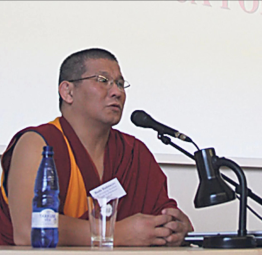 Buda Badmayev speaking at "Buddhism and Nordland".


Little Tibet at Veltsa
The third project had been waiting for twenty years. In about 2007 he went back to the Kaasiku farm at Veltsa, the site he had chosen by geomancy in the 1980s, to finish what had been interrupted. The rule in Tibet, he explained to a television crew, is that there should be water to the south and a mountain to the north. Estonia being short of mountains, he counted the rising ground towards Lihula as his mountain, and the pond on the south side he would dig himself.[53]
In 2008 he built the fifth stupa in Estonia there, ten metres high, together with a Fire Temple and a prayer wheel. The temple's frame was made of iron, because the clay and timber of Tibetan building would not survive the Estonian climate. Juniper smoked in the offering vessels in the yard, and long lines of prayer flags ran down from a mast. To his mind, he said, the whole of Tibet looked like "an entire fleet of ships spread out across the land".[53] Everything was paid for out of his own pocket and built by the small team of Estonian Nyingma. No Buddhist organisation in Estonia offered support. The help came from ordinary people in Tallinn and in the surrounding parish, who gave a little money, lent a cement mixer, or donated crushed stone and paint.[42]

He had no missionary intentions; "it is not my aim that Estonia should become Buddhist," he told the reporter. He cultivated Buddhism for himself, because he loved it; "since I produce a little more of it than I need, there is enough left over for others too, for those who come here asking for it".[53] To a newspaper he gave another explanation: "I am so old and have studied so much, become so wise, that the mind no longer takes in knowledge, it starts pushing out."[54] The plans for Veltsa included six stupas in all, a monastery and two prayer wheels that were to be the largest in Europe.[54]
Of the stupa itself he spoke in the terms he had learned at Ivolga. "For me, the stupa is a cosmic symbol. It represents a 3D mandala, and as my Guru Munko lama said – it is a direct connection to Shambhala." He related that when he had completed the dedication ritual at Veltsa, the stupa appeared one night to be on fire, and that when he and a friend approached to within five metres the fire vanished. Three nights later another visitor saw large, bright blue spheres, the width of the stupa's base, rising from it towards the sky. There were eight witnesses in all. He asked lamas who had built stupas what this might mean, and none of them could tell him. "Now I feel that I have to build more stupas because this connection with Shambhala may be useful!"[28]
After each conference the lecturers were taken out to Veltsa, and in 2010 the farm held an open day for the public.[50]
-
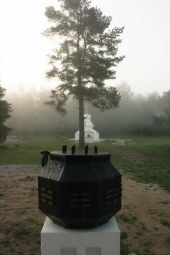 Morning at Veltsa: the incense burner and the stupa.
-
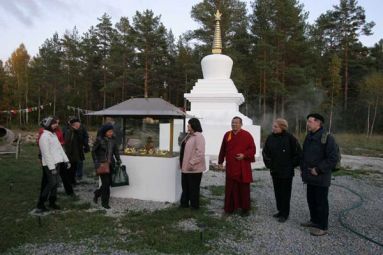 Lecturers of "Buddhism and Nordland" visiting the stupa and the Fire Temple at Veltsa.


Thangkas and Vesak
In these years he also took thangka painting somewhere new. He was the first to create thangkas in computer graphics, and he used three-dimensional modelling to design temples and mandalas. Works of this kind entered the collection of the Swedish Museum of Ethnography.[42]

In May 2011 he travelled to Bangkok with Marju Broder and Henri Lebedev for the United Nations Day of Vesak, where several thousand delegates from 87 countries had gathered, and delivered a speech of welcome on behalf of Estonian Nyingma. The Estonians presented Princess Srirasmi of Thailand with his thangka "Guru mandala". The princess, the Pärnu newspaper reported, asked a number of questions about the artist and about his distant country.[55][56]
The fifth "Buddhism and Nordland" met in Tallinn in September 2011. By then its founder was already at work on the other side of the world. Estonia, he had concluded while compiling his encyclopedia, was a very small country, and he could do something bigger.[28]
Australia, Buddhism & Australia and the Chinese / Tibetan Buddhist Encyclopedia (2010-2019)
- Main articles: International Conference Buddhism & Australia 2012-2021 - chronology from notices and calls for papers, The Chinese Buddhist Encyclopedia by Vello Vaartnou (PNC Conference, Berkeley, 7-9 December 2012), Background of Tibetan Buddhist Encyclopedia, Benefits of Tibetan Buddhist Encyclopedia, Introducing Stupas into Australia By Venerable Vello Vaartnou, Politics, Religion & Art, Make a Colourful Mix - From Estonia to Western Australia - Voice Newspapers, April 2011, Ja Lama with his Legends by Vello Vaartnou, My Understanding of Buddhism in Pictures - presentation by Vello Väärtnõu, Pacific Neighborhood Consortium (PNC) Annual Conference, 15 to 18 October 2019

Vello Väärtnõu moved to Western Australia in 2010. Friends who had settled there had invited him, and Australia granted him a Distinguished Talent visa in recognition of his educational and academic work.[9][57] He started at once on the largest projects of his life.
He made his home in a country house near York, east of Perth, which he shared for about ten years with his student Benny (Ivar Narep). The two of them lived a simple Buddhist life there. They hung prayer flags around the house, painted Buddhist statues and made thangkas, and built a Naga temple in the grounds under his Guru's direction. Vello explained its purpose with a straight face: the Australian countryside is full of snakes, some of them venomous. "So they would come to this temple for offerings, but otherwise they never bothered people in any way."[9] It was in this house that the encyclopedia was created.
-
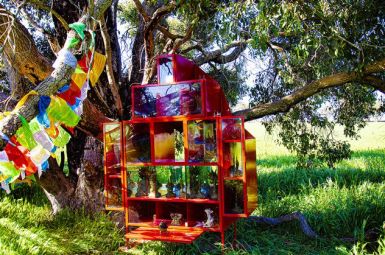 The Naga temple in York, Western Australia on the property where Vello lived

Buddhism & Australia
His first undertaking was a history. In 2011 he began to collect and preserve material on the history of Buddhism in Australia and set up the website Australian Buddhist History.[42] The second was a conference. Having run "Buddhism and Nordland" for five years, he saw no reason to stop merely because he had changed hemispheres, and from 2 to 4 February 2012 the first International Conference Buddhism & Australia met at Murdoch University in Perth. He told the local press that he hoped to help unite Perth's Buddhist community and to create a "contemporary Buddhist history" for the Western world.[58] He opened the conference himself, together with a federal senator, and the speakers included Ajahn Brahm and Professor Lewis Lancaster of the University of California, Berkeley.[59]

Buddhism & Australia was held annually for ten years, from 2012 to 2021, at Murdoch University, the University of Western Australia and Edith Cowan University, with the last meeting taking place online.[60] Marju Broder chaired the organising committee. Counting the Tallinn meetings, the conference of 2016 was already the tenth annual academic conference on Buddhism that Vello had organised.[60] In June 2012 he also held an exhibition at the Perth Town Hall.[42]
He had plans for Australian soil as well. In an article proposing the building of stupas in Western Australia he was introduced as a man who had been constructing them since 1982.[61] In 2016 he went through his earlier paintings and restored them so that they could be exhibited again.[62]
-
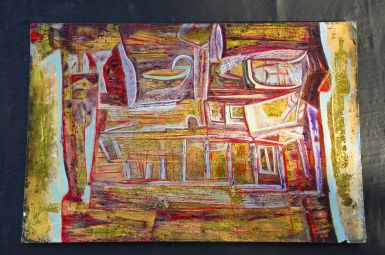 One of the earlier paintings that Vello Väärtnõu restored in Australia in 2016.

The Chinese Buddhist Encyclopedia
The idea that would occupy the rest of his working life had first come to him in 2005, while he was compiling his Estonian encyclopedia. "When I was doing this encyclopedia, it came to my mind that Estonia is such a small country, I could do something bigger."[28] The occasion arrived in 2012. Chinese monks who attended the first Perth conference invited him to China, and that spring he travelled to Beijing, Hong Kong and Taiwan to speak with abbots, scholars and ordinary Buddhists about a free online encyclopedia of Buddhism in the world's two most widely spoken languages, English and Chinese.[63][42]

Not everyone he met was encouraging. In Beijing one man warned him that translating Buddhist material without proper understanding would bring bad karma, and another told him that Buddhism required faith, not knowledge. Vello replied that before the man could begin to believe, knowledge of the subject had first to reach him.[29] Others were quicker to see the point. "Professor Lewis Lancaster from Berkeley University was the first person to support my project."[28] Lancaster, he was told, wondered aloud why such an idea had not occurred to him in thirty years, and invited Vello to present it at Berkeley.[42] Letters of support followed from scholars in Taiwan, Canada and India.[64]
The work itself began in the house near York. "I started encyclopedia with one friend," Vello later said.[28] The site went online in the autumn of 2012, and from 7 to 9 December Vello presented the Chinese Buddhist Encyclopedia at the conference of the Pacific Neighborhood Consortium at the University of California, Berkeley.[63]
He was clear about what the encyclopedia was for. Genuine teachings on the internet, he argued, were being buried under piles of opinion, and the same errors were copied from one site to the next. What was needed was a single place where a Buddhist could educate himself fully, free of charge. "This is my purpose in the life, to make Buddhism accessible to people for free. When Buddha Shakyamuni declared his teachings in the market-places, he didn’t ask money for this."[29] He was equally clear about what it was not. It would be academic and would gather material widely, from every school and every point of view, even though "everybody expects this site to be sweet and Buddhist". He had nothing against believers. "For me Buddhism has always been the source of knowledge and growth, and faith will develop itself, it is like a by-product."[29]
The name was chosen with some calculation. "Since Tibet is now, so to speak, under China, I thought that it would be good, somehow, to bring Tibetan Buddhism and Chinese Buddhism together. That was the cunning idea that occurred to me." Anyone who looked closely, he added, would find that almost all the articles were about Tibetan Buddhism.[9] The site was in time renamed the Tibetan Buddhist Encyclopedia, the name it bears today.
It grew at a remarkable rate. After its first year the encyclopedia contained more than 20,000 articles in English and 4,000 in Chinese, arranged in 36 main categories, together with Sanskrit, Pali, Tibetan, Japanese and Chinese dictionaries.[42] By April 2020 it held 62,000 articles, and about half a million people had read it, the most active of them the staff of universities.[9] The volunteers of the early days soon fell away, and Vello carried the daily work largely himself, by his own account eighteen hours a day and sometimes two days without a break. He paid for the servers out of his own pocket. "This will be my lifetime project."[28]
The encyclopedia and the conferences took him across Asia. He lectured in China many times, visited Taiwan, Singapore and Hong Kong, presented papers at the Pacific Neighborhood Consortium, among them a study of the legends of Ja Lama and, in 2019, "My Understanding of Buddhism in Pictures", illustrated with his own computer-painted thangkas and mandalas.[9][65] He even reached Papua New Guinea. Asked what he had done there, he said that first of all he had brought the people condensed milk, which they liked very much. "And, of course, I also told them about Buddhism."[9]
He believed that the future of the Dharma depended on work of this kind. "It is the computers that will build the bridge between the ancient form of Buddhism and the new generations, and if it is not done now, much will be lost."[66]
-
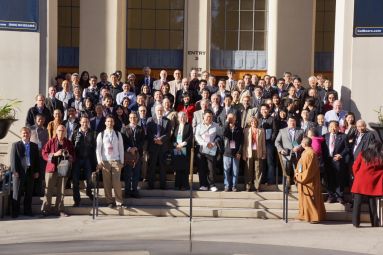 The Pacific Neighborhood Consortium conference at Berkeley, December 2012, where the encyclopedia was presented.
-
 The emblem of the Chinese Buddhist Encyclopedia.


Sweden: Swedish Buddhist Studies and the continuing work (from 2019)
- Main articles: Buddhism and Buddhist Studies in Sweden: Untapped Potential - Raymond Lam, Buddhistdoor Global, Thursday, 10 September 2020, Letters of Support for Swedish Buddhist Studies (SBS), the Project of Vello Väärtnõu - April and May 2020, Vello Vaartnou: A Life Devoted to Dharma, When the Buddha Came to Ultima Thule: Call for Papers for the Sixth International Conference Buddhism and Nordland

Vello Väärtnõu returned to Stockholm in about 2019, after some ten years in Australia. He brought with him the encyclopedia, a large library of books and manuscripts, and a new plan.
Sweden, he had noticed, had no academic Buddhist studies at all: no centre, no programme, not a single university scholar who specialised in the subject. He founded an association, Swedish Buddhist Studies, to change this. "Swedish Buddhist studies will bring Buddhism together on the same level as Christian and Islamic studies," he said. "Islam and Christianity are both world religions, but Buddhism is also one."[67] In April and May 2020 scholars and monks from Russia, Thailand, China, India and Germany wrote letters in support of the project.[68]
The response at home was cooler. He wrote about the encyclopedia and the association to universities, to the Royal Swedish Academy of Sciences, to newspapers and to politicians, sixty-eight officials in all, and received no answers.[67][28] His circumstances were modest. "I live in my friend’s apartment and I have 6 square meters to use. For me and for my computer it is enough," he told Buddhistdoor Global, adding only that his books needed a small room of their own.[28] None of this interrupted the work. A student described him that year as "69 years old and still working every day".[67]
He was generous in acknowledging those who helped him. Of Marju Broder, who had been secretary of his conferences since 2007 and had presented her own papers at Berkeley, he said: "Her work is always connected to mine. She even takes part in the Berkeley conferences with her own presentations. She is a very smart Buddhist. I can’t imagine my work without her."[28]
The projects continued on both sides of the world. The tenth International Conference Buddhism & Australia was held online in February 2021.[69] That June a call for papers announced the revival of his first conference series after ten years: the sixth "Buddhism and Nordland", under the title "When the Buddha Came to Ultima Thule", to be held in Sweden on 19 and 20 November 2021. By then the encyclopedia had reached 76,770 articles.[57] It later passed 81,000.[70]
In the spring of 2020 he gave a long interview in which he looked back over everything from his grandparents' attic to the encyclopedia. Asked at the end of another conversation that year for a blessing, he gave one that may stand for all his work:
"I wish happiness to each house, to each person, each living being here in samsara. No war, no suffering. And for ourselves, the most important thing in our life: to encounter and practice the teachings of the Buddha."[28]
-
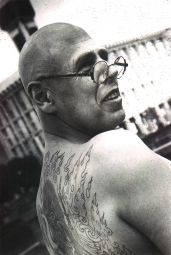 Vello Väärtnõu in Stockholm.
-
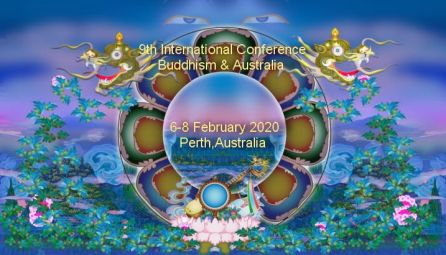 The International Conference Buddhism & Australia, 2020.


Vello Väärtnõu as teacher and thinker
- Main articles: Introduction to Meditation - Vello Väärtnõu, To Understand Tantrism and Get the Hang of It - Vello Väärtnõu's essay on tantrism, the senses and visualisation, 2010, The Five Dhyani Buddhas and the Five Senses - Vello Väärtnõu, Padma, the Women and King Trisong Detsen - Vello Väärtnõu's essay on Guru Padmasambhava, the Vajra Guru and the classes of tantra, Shambala (Шамбалын орон) - Vello Väärtnõu's essay on Agvan Dorzhiev, Dza Lama, Baron Ungern and Karl Tõnisson (complete text), Karl Tõnisson, the Father of Estonian Buddhism - Vello Väärtnõu

Vello Väärtnõu did not think of himself as a preacher. "I do not teach so much. I prefer disseminating philosophy, the Buddhist worldview, psychology, rituals, and so on."[28] Everything he did, from the hand-bound translations of Taola to the encyclopedia, followed from that preference. He wanted people to have the means to understand Buddhism for themselves.
For him Buddhism was first of all knowledge. "For me, Buddhism is not so much a religion as a science," he said in 2020. Its principal science was psychology, the study of feeling, perception and thought, because the task Buddhism sets itself is to know oneself. Rituals and temples, in his view, are needed by those whose attention is directed outward; for those who look inward, philosophy and psychology become the most important things in the world. The deities he described as "computer programs for our mind".[9]
His own inclination was towards logic and philosophy, the tradition of Dignāga and Dharmakīrti, and above all the Yogācāra school. He thought Aristotle "somewhat naive" by comparison. "Yogācāra is above all else! I call it 'golden Yogācāra,' because for me it is the foundation of all genuinely philosophical knowledge!"[9] Tantra, too, he regarded as a science, since everything arises from the mind. His essays on meditation and tantra begin accordingly with the five senses and consciousness, relate the five Dhyani Buddhas to the senses, and treat visualisation as the tantric practitioner's reading and writing.[71][72]
He insisted on proper preparation and on the teacher. In the Gelug tradition in which he had been trained, he pointed out, nobody began tantra without first studying philosophy in depth, and he found much Western practice superficial: "well, they recite some mantras, do some practices, and that's it!"[9] Tantra, he wrote, always works through the text and the Guru together. "The text, if one knows it by heart, may be absent, but the Guru must always be there."[73] At the same time he saw no need for every student to learn Asian languages. "Everything should be assimilated in one's own language."[9] It was the conviction behind every translation he made or commissioned.
His allegiance never changed. He had studied among the Gelug and counted himself a Nyingma all his life, and when asked why, he gave the shortest answer of his career: "Because that is where Padmasambhava is, and I adore him!"[9]
He was also a historian of Buddhism in the north. He wrote on Karl Tõnisson, whom he called the father of Estonian Buddhism, on Agvan Dorzhiev, Dza Lama and Baron Ungern von Sternberg, and on the Buryat teachers Lubsan Samdan Tsydenov and Bidia Dandaron, always with the aim of telling their history from the Buddhist point of view.[74][75] Academic scholars in Soviet Estonia had once referred to the practitioners of Taola as "village mystics", convinced that they knew more about Buddhism than the Buddhists did. "I think they were right," he said, and laughed.[9]
-
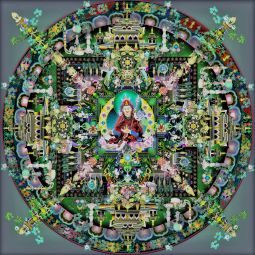 Guru Rinpoche mandala by Vello Väärtnõu.

Vello Väärtnõu as artist
- Main articles: Art of Vello Vaartnou - gallery of paintings, Buddhist art and exhibitions, Vello Vaartnou VanTao Art - art catalogue of Master VanTao (Vello Väärtnõu), 2019, Vello Vaartnou thangka's, Artist Vello Väärtnõu Between East and West - interview by Sulev Teinemaa

Vello Väärtnõu painted for more than forty years, and he worked in two quite different idioms: the abstract and figurative painting of a European artist, and the thangkas and mandalas of a Buddhist one. He saw no contradiction between them. Both, he held, were records of the mind.
"From my point of view, a painting is the visual expression of psychic states. Reality is not a portrait, not a still life, not a landscape; reality is a state of mind."[9] Colour he called the purest substance available to us. He put no predetermined meaning into his pictures, and he thought abstraction richer than realism because its possibilities were unlimited. An abstract painting, as he understood it, records in colour and line the states of mind in which it was made, and can therefore be considered from the standpoint of Yogācāra. The blank white sheet is a manifestation of emptiness; "paintings arise out of chaos".[9]
Eve Pärnaste, writing in 1991, described the result from the outside. Whether he had painted a figure, a landscape or an abstraction mattered little; what was decisive was colour, surface and texture. He favoured mixed technique and often gave his pictures an "old" air, with a dense, deep range of colour that recalled the European old masters, while his training in thangka painting had taught him the Eastern rules for the effect of colour on the mind. A picture, he maintained, does not have to say anything, but it must create a mood.[3]
His Buddhist art began in Taola with silkscreen thangkas, painted khadags and statues, made for the Brotherhood and for the monasteries of Buryatia. From about 2000 he became one of the first artists to create thangkas and mandalas in computer graphics, and he used three-dimensional modelling to design temples. Sixty-three of these works, made between 2000 and 2019, are gathered in the catalogue published under his Chinese name, Master VanTao.[42][76] He made light of the skill involved. "Thangkas are simple. I simply meditate, and I see them." An uncle of the King of Bhutan, he recalled, once looked at them and said that they were not real thangkas. "Perhaps he is right."[9]
His paintings were exhibited in Estonia from 1980, across Europe after 1988, and later in Kyiv, Tallinn and Perth, and his works are held by the Museum of Ethnography in Stockholm, by collections in San Francisco and Bangkok, by the Thai royal family and by private collectors.[42][9] In his last working decades he painted very little. "I now have almost no time to paint pictures or thangkas, because all my time goes into working on the Encyclopedia."[9]
-
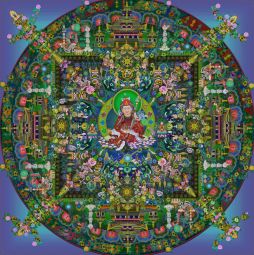 Guru Rinpoche mandala
-
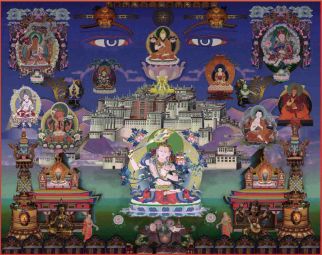 Manjushri and the Potala
-
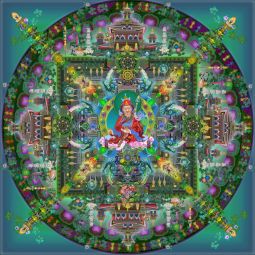 Guru mandala, 2001
-
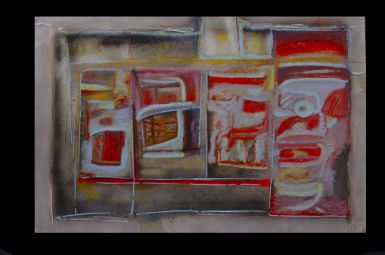 Abstract composition by Vello Väärtnõu.


Writings
- Main category: Category:Vello Väärtnõu own writings and works
Vello Väärtnõu wrote in Estonian, Russian and English. The following texts of his are published in the Tibetan Buddhist Encyclopedia, most of them with an English translation.
On Buddhist practice and doctrine
- Introduction to Meditation - Vello Väärtnõu
- To Understand Tantrism and Get the Hang of It - Vello Väärtnõu's essay on tantrism, the senses and visualisation, 2010
- The Five Dhyani Buddhas and the Five Senses - Vello Väärtnõu
- Padma, the Women and King Trisong Detsen - Vello Väärtnõu's essay on Guru Padmasambhava, the Vajra Guru and the classes of tantra
- The Nyingmapa and Tibet - Vello Väärtnõu's essay on the Red Hat school and the birth of Guru Padmasambhava
- The Life of Padmasambhava - Vello Väärtnõu's slide show, 2008
- Sadhana - Vello Väärtnõu's article on sadhana practice and the Vajrayogini sadhana
- Vajrayogini - Vello Väärtnõu's article on the dakini Vajrayogini (Vajravarahi)
- Akshobhya (Akshobja) - Vello Väärtnõu's article on the dhyani Buddha Akshobhya, Mara and the mirror-like wisdom
- Dorje Legpa - Vello Väärtnõu's article on the Nyingma Dharma protector
- Mindroling - Vello Väärtnõu's article on the Nyingma monastery Mindroling
- The Turtle Shell (Kilpkonna kilp) - Vello Väärtnõu's writing on Buddhist astrology (complete text)
- My Understanding of Buddhism in Pictures - presentation by Vello Väärtnõu, Pacific Neighborhood Consortium (PNC) Annual Conference, 15 to 18 October 2019
On the history of Buddhism
- Karl Tõnisson, the Father of Estonian Buddhism - Vello Väärtnõu
- Karl Tõnisson, Agvan Dorzhiev, Dza Lama and Baron Ungern - Vello Väärtnõu's paper at the Agvan Dorzhiev Readings, St Petersburg, 11 November 2006
- Shambala (Шамбалын орон) - Vello Väärtnõu's essay on Agvan Dorzhiev, Dza Lama, Baron Ungern and Karl Tõnisson (complete text)
- Introduction to Dza Lama - Vello Väärtnõu's essay on Ja Lama, rebirth and the Shambala warriors
- Dza Lama (Damba Dzjamtsan Lamaa) - Vello Väärtnõu's sketch of the life of Ja Lama
- Ja Lama with his Legends by Vello Vaartnou
- The Ungerns (Ungernid) - Vello Väärtnõu's essay on the family and relatives of Baron Roman Ungern von Sternberg
- Lubsan Samdan Tsydenov, Bidia Dandaron and The abbot of Kumbum by Vello Vaartnou
- The Estonian Buddhist Brotherhood (Taola), 1983-1988 - Vello Väärtnõu's talk in St Petersburg, 2007
On the Encyclopedia and his projects
- The Chinese Buddhist Encyclopedia by Vello Vaartnou (PNC Conference, Berkeley, 7-9 December 2012)
- Background of Tibetan Buddhist Encyclopedia
- Benefits of Tibetan Buddhist Encyclopedia
- Introducing Stupas into Australia By Venerable Vello Vaartnou
- Welcoming Speech by Vello Väärtnõu in the 8th Conference of the United Nations Day of Vesak
Memoirs
- Women and Smell - Vello Väärtnõu's story of his mother, his grandmothers Viiu and Martha and his childhood, 2010
- Petrozavodsk Prison - Vello Väärtnõu's story of his first morning in prison and at the KGB, 2010
- First Day in Prison - Vello Väärtnõu's story of his first KGB interrogation and his first night in Petrozavodsk prison, 2010
- Inno ja Irja: Vabadusvõitleja Vello Väärtnõu meenutused Komi vangilaagrist, 20 December 2021
- My Story: the ERSP, the Drive to Moscow and My Expulsion - Vello Väärtnõu's own account
Recognition and letters of support
- Main articles: Letters of Support for the Chinese Buddhist Encyclopedia from Scholars and Buddhists - 2012 to 2019, Letters of Support for the Chinese Buddhist Encyclopedia from Chinese Business and Cultural Leaders - 2012, Letters of Support about Vello Väärtnõu and the International Conference Buddhism & Australia - 2011 to 2016, Letters of Support about Vello Väärtnõu, Estonian Nyingma and the Conferences "Buddhism and Nordland" - 2011 and 2012, Letters of Support for Swedish Buddhist Studies (SBS), the Project of Vello Väärtnõu - April and May 2020, Vello Väärtnõu in Books - Passages from Books and Theses, 1982 to 2026
Vello Väärtnõu worked for most of his life without institutional backing, and the recognition he received came chiefly from the scholars and monastics who knew his work at first hand. Their letters, written between 2011 and 2020, are collected in the Encyclopedia.
The Ivolginsky Datsan confirmed in 2011 that he had studied there under two Pandito Hambo Lamas and expressed its appreciation of his conferences and of the work of Estonian Nyingma.[77] Scholars who had spoken at "Buddhism and Nordland" and at Buddhism & Australia wrote in support of both conference series.[78][79] The encyclopedia was endorsed from 2012 onwards by Professor Lewis Lancaster of Berkeley, who was the first to support it, by scholars in Taiwan, Canada and India, and by Chinese business and cultural organisations.[80][81] In 2020 seven scholars and monks from Russia, Thailand, China, India and Germany wrote on behalf of Swedish Buddhist Studies.[82]
Australia granted him a Distinguished Talent visa for his educational and academic projects.[83] His life and work are discussed in histories of the Estonian independence movement, in studies of religion in Estonia and in a number of academic theses, and he has been the subject of newspaper and magazine articles in many countries since the 1980s.[84]
The work continues
- Main articles: Background of Tibetan Buddhist Encyclopedia, Benefits of Tibetan Buddhist Encyclopedia
Vello Väärtnõu always described the encyclopedia as a project that would outlast those who began it. Among the principles he set down for it in 2012 is this one: "The Encyclopedia is a lifelong project, which means over the coming decades, the structure of the encyclopedia might change, as well as the working collective will be replaced with a younger generation, which if guided properly can benefit the project and the impact of the project." The encyclopedia, he wrote, "carries key value for the following generations, who will read, use and further develop the encyclopedia and the field of Buddhist knowledge".[85]
That is what has happened. The Tibetan Buddhist Encyclopedia is today cared for by Benny, the student with whom Vello began it in the house near York, Western Australia in 2012. Benny is its main administrator and caretaker and does this work alone at the moment. He has dedicated his life to carrying on his Guru's legacy, so that the work lives on and continues to bring the Dharma, freely, to readers all over the world.
On 10 November 2026 the Encyclopedia contained 93,565 entries. It remains free to everyone, as its founder intended, and it is supported entirely by the donations of its readers, which cover the cost of its servers and its upkeep. In September 2026 the developer Dmytro Rudiy joined the work and has since helped to bring the site up to current technical standards. Before him the technical side was looked after by Vello's close friend Eugene Rossin.
Asked in 2020 what inspired him to go on with a task of this size, Vello Väärtnõu answered in four words: "Above all, knowledge itself!"[9]
See Also
- Estonian Nyingma
- The first Estonian Buddhist Brotherhood
- Building the first stupas of northern Europe in 1983–1985
- International Conference Buddhism and Nordland 2007-2021 - history, and the Estonian Wikipedia article "Budism ja Põhjala"
- International Conference Buddhism & Australia 2012-2021 - chronology from notices and calls for papers
- Background of Tibetan Buddhist Encyclopedia
- Art of Vello Vaartnou - gallery of paintings, Buddhist art and exhibitions
- Vello Väärtnõu in Books - Passages from Books and Theses, 1982 to 2026
- Category:Vello Väärtnõu
- Category:Vello Väärtnõu own writings and works
- Category:Vello Väärtnõu in Newspapers
- Category:Vello Väärtnõu Videos
References
- ↑ Budismi entsüklopeedia koostaja Vello Väärtnõu: Budism on mu ainus kirg
- ↑ Artist Vello Väärtnõu: "Reality Is Not a Portrait, Not a Still Life, Not a Landscape, Reality Is a State of Mind" - interview by Vlada Belimova, 28 April 2020
- ↑ 3.00 3.01 3.02 3.03 3.04 3.05 3.06 3.07 3.08 3.09 3.10 3.11 3.12 3.13 3.14 3.15 3.16 3.17 3.18 3.19 3.20 3.21 3.22 3.23 3.24 About Vello Väärtnõu, 13 September 1991 - Eve Pärnaste
- ↑ Vello Väärtnõu - Estonian World Review
- ↑ 5.0 5.1 5.2 5.3 5.4 5.5 Vello Väärtnõu's Family and Youth in the Estonian Press, 1954 to 2016 - his father Captain Arseni Väärtnõu, his mother Ida and the young swimmer
- ↑ 6.0 6.1 6.2 6.3 Women and Smell - Vello Väärtnõu's story of his mother, his grandmothers Viiu and Martha and his childhood, 2010
- ↑ 7.0 7.1 7.2 7.3 First Day in Prison - Vello Väärtnõu's story of his first KGB interrogation and his first night in Petrozavodsk prison, 2010
- ↑ 8.0 8.1 BUDDHIST AGAINST EMPIRE by Marju Broder
- ↑ 9.00 9.01 9.02 9.03 9.04 9.05 9.06 9.07 9.08 9.09 9.10 9.11 9.12 9.13 9.14 9.15 9.16 9.17 9.18 9.19 9.20 9.21 9.22 9.23 9.24 9.25 9.26 9.27 9.28 9.29 9.30 9.31 9.32 9.33 9.34 9.35 9.36 9.37 9.38 9.39 9.40 9.41 Artist Vello Väärtnõu: "Reality Is Not a Portrait, Not a Still Life, Not a Landscape, Reality Is a State of Mind" - interview by Vlada Belimova, 28 April 2020
- ↑ His age at the time varies between accounts: about eleven in his 2020 interview, ten to twelve in the Estonian World Review, and thirteen in the Taiwanese press of 2012. See Vello Väärtnõu - Estonian World Review and Estonian Monk Visits Taiwan to Build Online Buddhist Encyclopedia - Focus Taiwan (CNA), Sunday, 1 July 2012.
- ↑ Estonian Monk Visits Taiwan to Build Online Buddhist Encyclopedia - Focus Taiwan (CNA), Sunday, 1 July 2012
- ↑ Vello's own accounts place this first arrest in June 1969: "Age 17. A month later I turned 18." Eve Pärnaste (1991) gives 20 June 1970, and Viktor Niitsoo (2002) writes of an attempt in 1971 together with Jüri Lipp and a sentence of two years. See About Vello Väärtnõu, 13 September 1991 - Eve Pärnaste and The Wall Breakers: The Story of MRP-AEG and the ERSP (Viktor Niitsoo, 2002) - Vello Väärtnõu and the Proposal to Found the ERSP.
- ↑ 13.0 13.1 13.2 13.3 13.4 13.5 13.6 Petrozavodsk Prison - Vello Väärtnõu's story of his first morning in prison and at the KGB, 2010
- ↑ Eve Pärnaste places the camp at Vuktyl, near Pechora; Vello's own memoir of the camp is set at Vezaika, near the railway station of Mikun. See Inno ja Irja: Vabadusvõitleja Vello Väärtnõu meenutused Komi vangilaagrist, 20 December 2021.
- ↑ 15.0 15.1 15.2 Inno ja Irja: Vabadusvõitleja Vello Väärtnõu meenutused Komi vangilaagrist, 20 December 2021
- ↑ 16.0 16.1 About one interesting man Newspaper “Leole” 4.17.2001 by Tõnu Kukk
- ↑ 17.00 17.01 17.02 17.03 17.04 17.05 17.06 17.07 17.08 17.09 17.10 17.11 17.12 17.13 17.14 17.15 17.16 17.17 17.18 17.19 17.20 17.21 The Estonian Buddhist Brotherhood (Taola), 1983-1988 - Vello Väärtnõu's talk in St Petersburg, 2007
- ↑ 18.0 18.1 18.2 18.3 18.4 Vello Väärtnõu - Leebe brutaal
- ↑ The Picturesque Islander - Nezavisimost (Kyiv), Friday, 27 June 1997
- ↑ 20.0 20.1 20.2 Tibet in Estonia - Tarmo Teder “Existentia 3” p 38-41, 1985
- ↑ Astrology lecture by Vello Vaartnou at the Russian Club in Stockholm - flyer, Friday 5 June
- ↑ 'BUDDHISM & AUSTRALIA' ОЛОН УЛСЫН БАГА ХУРАЛ БА ЭСТОНИЙН БУРХНЫ ШАШНЫ УЛАМЖЛАЛ
- ↑ Vello Väärtnõu in the Estonian Press, 2009 to 2025 - the ERSP, the Buddhist Brotherhood, "Little Tibet" at Veltsa, the Encyclopedia, his paintings and his 70th birthday
- ↑ Artist Vello Väärtnõu Between East and West - interview by Sulev Teinemaa
- ↑ Vello Väärtnõu in the Estonian Art and Architecture Biographical Lexicon (EKABL) - his five group exhibitions in Estonia, 1980 to 1982
- ↑ Letter of the Ivolginsky Datsan "Khambin Sume" about Vello Väärtnõu and Estonian Nyingma - Dagba Lama (D. D. Ochirov), 4 March 2011
- ↑ Other accounts give different years for his first journey to Ivolga, from the mid-1970s to September 1980. Vello himself spoke of eight years of study. See About Vello Väärtnõu, 13 September 1991 - Eve Pärnaste and Ivolginski Datsan by Marju Broder.
- ↑ 28.00 28.01 28.02 28.03 28.04 28.05 28.06 28.07 28.08 28.09 28.10 28.11 28.12 28.13 28.14 28.15 Vello Vaartnou: A Life Devoted to Dharma
- ↑ 29.0 29.1 29.2 29.3 29.4 29.5 29.6 Background of Tibetan Buddhist Encyclopedia
- ↑ 30.0 30.1 30.2 30.3 30.4 Estonian Nyingma and Databases by Marju Broder
- ↑ The preparations began in 1982, the year given for the founding by Eve Pärnaste and by the Tartu exhibition of 2009; the regular work of the Brotherhood dates from 1983. See About Vello Väärtnõu, 13 September 1991 - Eve Pärnaste.
- ↑ 32.0 32.1 Kife: The Lives and Dreams of Soviet Youth (1989) - Vello Väärtnõu and the Estonian Buddhists
- ↑ Drive to the Countryside! 33 - ETV, 28 November 2009 - Vello Väärtnõu and the Little Tibet at Veltsa (VIDEO)
- ↑ 34.0 34.1 Vello Väärtnõu Arrested in Karelia in 1982 and Held as a Political Prisoner - reports in the Estonian exile press, 1983 to 1986
- ↑ Vello Väärtnõu in the Estonian Press, 2009 to 2025 - the ERSP, the Buddhist Brotherhood, "Little Tibet" at Veltsa, the Encyclopedia, his paintings and his 70th birthday
- ↑ The Wall Breakers: The Story of MRP-AEG and the ERSP (Viktor Niitsoo, 2002) - Vello Väärtnõu and the Proposal to Found the ERSP
- ↑ 37.0 37.1 37.2 The Wall Breakers: The Story of MRP-AEG and the ERSP (Viktor Niitsoo, 2002) - Vello Väärtnõu and the Proposal to Found the ERSP
- ↑ 38.0 38.1 38.2 38.3 My Story: the ERSP, the Drive to Moscow and My Expulsion - Vello Väärtnõu's own account
- ↑ In Soviet Baltic, an Unintended Openness - The New York Times, Wednesday, 10 February 1988
- ↑ Vello Väärtnõu Detained, Searched by the KGB and Expelled - reports in the Estonian exile press, January to April 1988
- ↑ Soviet Authorities Expel Five Estonians - Associated Press, 3 April 1988
- ↑ 42.00 42.01 42.02 42.03 42.04 42.05 42.06 42.07 42.08 42.09 42.10 42.11 42.12 42.13 Budismi entsüklopeedia koostaja Vello Väärtnõu: Budism on mu ainus kirg
- ↑ 43.0 43.1 43.2 I Will Be Sure of Coming Back Only When I Am Here Again - Estonian artist Vello Väärtnõu left on a car journey to his homeland - Monday, 19 June 1989
- ↑ Vello's New Life in a Two-Room Flat in Akalla - Prisoner in Siberia and Monk in Mongolia - Ny i Sverige 4/1989
- ↑ Vello Väärtnõu in the Estonian Press, 1989 to 1998 - exhibitions, return visits and remembrance
- ↑ Vello Väärtnõu - Leebe brutaal
- ↑ Astrology lecture by Vello Vaartnou at the Russian Club in Stockholm - flyer, Friday 5 June
- ↑ The Picturesque Islander - Nezavisimost (Kyiv), Friday, 27 June 1997
- ↑ Karl Tõnisson, Agvan Dorzhiev, Dza Lama and Baron Ungern - Vello Väärtnõu's paper at the Agvan Dorzhiev Readings, St Petersburg, 11 November 2006
- ↑ 50.0 50.1 50.2 International Conference Buddhism and Nordland 2007-2021 - history, and the Estonian Wikipedia article "Budism ja Põhjala"
- ↑ MTÜ Eesti Njingma - Annual Report for 2011 (final report of the association, liquidated 2011)
- ↑ Letter of the Ivolginsky Datsan "Khambin Sume" about Vello Väärtnõu and Estonian Nyingma - Dagba Lama (D. D. Ochirov), 4 March 2011
- ↑ 53.0 53.1 53.2 Drive to the Countryside! 33 - ETV, 28 November 2009 - Vello Väärtnõu and the Little Tibet at Veltsa (VIDEO)
- ↑ 54.0 54.1 A Buddhist Park Comes to the Land of the Estonian Prophet - Maaleht, Thursday, 16 July 2009
- ↑ Pärnumaa Buddhists Gave the Thai Princess a Thangka Made by Vello Väärtnõu - Anu Jürisson, Pärnu Postimees, 29 June 2011
- ↑ Welcoming Speech by Vello Väärtnõu in the 8th Conference of the United Nations Day of Vesak
- ↑ 57.0 57.1 When the Buddha Came to Ultima Thule: Call for Papers for the Sixth International Conference Buddhism and Nordland
- ↑ Estonian monk on mission to enlighten - 24, January.2012 - The West Australian
- ↑ 'BUDDHISM & AUSTRALIA' ОЛОН УЛСЫН БАГА ХУРАЛ БА ЭСТОНИЙН БУРХНЫ ШАШНЫ УЛАМЖЛАЛ
- ↑ 60.0 60.1 International Conference Buddhism & Australia 2012-2021 - chronology from notices and calls for papers
- ↑ Introducing Stupas into Australia By Venerable Vello Vaartnou
- ↑ Art of Vello Vaartnou - gallery of paintings, Buddhist art and exhibitions
- ↑ 63.0 63.1 The Chinese Buddhist Encyclopedia by Vello Vaartnou (PNC Conference, Berkeley, 7-9 December 2012)
- ↑ Letters of Support for the Chinese Buddhist Encyclopedia from Scholars and Buddhists - 2012 to 2019
- ↑ My Understanding of Buddhism in Pictures - presentation by Vello Väärtnõu, Pacific Neighborhood Consortium (PNC) Annual Conference, 15 to 18 October 2019
- ↑ Estonian Monk Visits Taiwan to Build Online Buddhist Encyclopedia - Focus Taiwan (CNA), Sunday, 1 July 2012
- ↑ 67.0 67.1 67.2 Buddhism and Buddhist Studies in Sweden: Untapped Potential - Raymond Lam, Buddhistdoor Global, Thursday, 10 September 2020
- ↑ Letters of Support for Swedish Buddhist Studies (SBS), the Project of Vello Väärtnõu - April and May 2020
- ↑ International Conference Buddhism & Australia 2012-2021 - chronology from notices and calls for papers
- ↑ The Tibetan Buddhist Encyclopedia: A Cause Worth Supporting
- ↑ To Understand Tantrism and Get the Hang of It - Vello Väärtnõu's essay on tantrism, the senses and visualisation, 2010
- ↑ The Five Dhyani Buddhas and the Five Senses - Vello Väärtnõu
- ↑ Padma, the Women and King Trisong Detsen - Vello Väärtnõu's essay on Guru Padmasambhava, the Vajra Guru and the classes of tantra
- ↑ Karl Tõnisson, the Father of Estonian Buddhism - Vello Väärtnõu
- ↑ Lubsan Samdan Tsydenov, Bidia Dandaron and The abbot of Kumbum by Vello Vaartnou
- ↑ Vello Vaartnou VanTao Art - art catalogue of Master VanTao (Vello Väärtnõu), 2019
- ↑ Letter of the Ivolginsky Datsan "Khambin Sume" about Vello Väärtnõu and Estonian Nyingma - Dagba Lama (D. D. Ochirov), 4 March 2011
- ↑ Letters of Support about Vello Väärtnõu, Estonian Nyingma and the Conferences "Buddhism and Nordland" - 2011 and 2012
- ↑ Letters of Support about Vello Väärtnõu and the International Conference Buddhism & Australia - 2011 to 2016
- ↑ Letters of Support for the Chinese Buddhist Encyclopedia from Scholars and Buddhists - 2012 to 2019
- ↑ Letters of Support for the Chinese Buddhist Encyclopedia from Chinese Business and Cultural Leaders - 2012
- ↑ Letters of Support for Swedish Buddhist Studies (SBS), the Project of Vello Väärtnõu - April and May 2020
- ↑ When the Buddha Came to Ultima Thule: Call for Papers for the Sixth International Conference Buddhism and Nordland
- ↑ Vello Väärtnõu in Books - Passages from Books and Theses, 1982 to 2026
- ↑ Benefits of Tibetan Buddhist Encyclopedia